

Match 6 - 🇺🇸 Jack Bauer VS Harry Pearce 🇬🇧
🏆 WORLD’S GREATEST CSO COMPETITION 🏆
ABOUT THE COMPETITION FORMAT
Round One assesses foundational leadership capability, applying the standard the panel sharpened in the previous match: that a Chief Security Officer requires not merely tactical or technical capability but governance legitimacy and programme transferability, the capacity to build security functions that outlast the individual who built them. This match tests that standard against its most demanding case yet. Both candidates operate, at least nominally, within legitimate state authority. Both have, at various points, treated that authority as an inconvenience.
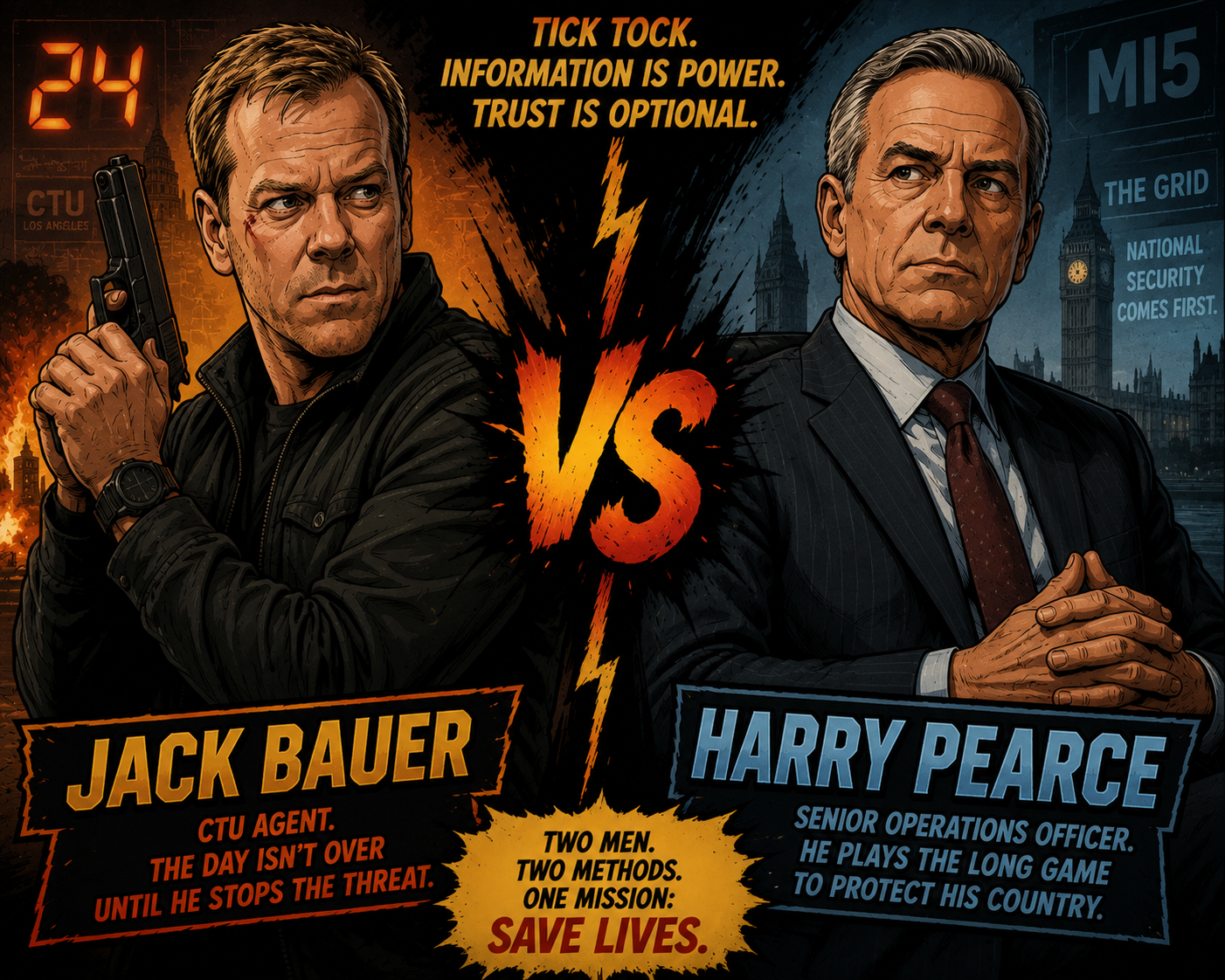
One has personally prevented more terrorist attacks, nuclear detonations, and assassinations than any other security professional in fiction, usually within a single working day and usually by means that no employment tribunal would survive hearing about. The other has run a section of the British Security Service for the better part of three decades, surviving political administrations, parliamentary oversight committees, and an alarming number of moles within his own building, without anyone outside a small circle of Whitehall ever learning his name. Both men have done terrible things in the service of national security. Only one of them has built an institution that could plausibly continue without him.
The Necessary Evil Problem
Every candidate so far has occupied a reasonably clear position on the spectrum between legitimate authority and its absence. This match is different, because both Jack Bauer and Harry Pearce operate within genuinely legitimate state security frameworks and have spent their careers deciding, repeatedly and consequentially, when that framework should be set aside.
This is not the Dredd problem, in which the absence of external accountability is structural and total. Both CTU and Section D answer, in principle, to oversight: presidential authority and congressional committees in Bauer's case, the Home Secretary and the Joint Intelligence Committee in Pearce's. It is also not the Gus problem, in which the entire enterprise is illegitimate from its foundation. Both men work for governments. The question this match poses is narrower and, in some ways, more uncomfortable: when a legitimate security professional decides that the rules constraining them are an obstacle to the mission rather than a constraint upon it, what distinguishes a defensible exception from a habit that will eventually destroy the institution making it?
Bauer and Pearce answer this question in almost opposite ways, and the distance between their answers is the substance of this article.
Setting the Scene
Jack Bauer is a field agent, latterly a senior operative, of the Counter Terrorist Unit's Los Angeles office, whose career consists of an unbroken sequence of the worst single days imaginable, each one somehow worse than the last. He has stopped nuclear detonations on domestic soil, prevented the release of biological and chemical weapons, foiled multiple presidential assassinations, and done so with a personal toll, in terms of relationships destroyed, laws broken, and physical and psychological damage sustained, that no organisation could reasonably ask of an employee and that Bauer has never once declined to pay. He is, without serious competition, the most effective single-incident operator this competition has yet assessed.
Harry Pearce is the long-serving Section Chief of Section D, the counter-terrorism arm of MI5 operating from a facility known internally as the Grid. His career spans decades, multiple changes of government, the management and mentorship of successive generations of intelligence officers, and a continuous, exhausting negotiation between what his service needs to do to protect the country and what his political masters can survive having authorised. He has run double agents, sacrificed assets, lied to ministers, and authorised operations of considerable moral ambiguity. He has also built and sustained an institution that has survived his own near-misses, his own moles, and the deaths of a substantial proportion of his staff, and that continues to function because he built it to function with or without him in the room.
Protective Security
Bauer's protective security capability, narrowly defined as the ability to keep a specific principal alive under direct and immediate threat, is exceptional. He has personally protected presidents, secretaries of state, and senior officials through assassination attempts of extraordinary sophistication, frequently while every conventional protective apparatus around him has failed or been compromised. His instinct for threat recognition is close to unmatched in this competition, and his willingness to absorb personal risk on behalf of a principal is total and immediate.
Pearce's protective security operates at a different scale and through different mechanisms. He is less frequently the last line of physical defence and more frequently the architect of the broader intelligence picture that prevents the threat from reaching the principal at all. His protective security is preventive and systemic rather than reactive and personal: disrupting plots before they reach the operational stage, managing the broader threat environment, and maintaining the kind of sustained situational awareness across the national threat picture that no single tactical intervention can replicate.
Advantage: Bauer. In the narrow, high-stakes, immediate-threat scenario that protective security ultimately exists to address, his record is the strongest in the competition.
Crisis Leadership
Bauer's crisis leadership within a single incident is extraordinary. He processes new information at remarkable speed, revises his plan continuously as the situation evolves, and maintains operational clarity under conditions of sustained extreme stress that would incapacitate most professionals within the first hour, let alone across twenty-four. His tactical crisis leadership, narrowly defined, may be the strongest in this competition.
His crisis leadership has a significant and consistent limitation: it does not extend to leading an institution through a crisis. Bauer leads himself, and occasionally a small team, through acute danger with extraordinary skill. He does not manage CTU through the political, reputational, and operational consequences of the crisis once the immediate threat has passed, because he is characteristically unavailable, off the grid, or under arrest by the time those consequences need managing. Someone else inherits that work, and CTU's revolving cast of directors suggests the inheritance is rarely a pleasant one.
Pearce's crisis leadership operates on a longer timeline and a wider scope. He manages his team through the incident, manages the political fallout that follows it, manages the relationship with ministers who would prefer the incident had not happened and would very much prefer not to know how it was resolved, and does all of this while maintaining the cohesion of an organisation that has just lost, with some regularity, one of its own people. His crisis leadership is less visually dramatic than Bauer's and considerably more complete.
Advantage: Shared. Bauer's tactical crisis performance and Pearce's organisational crisis stewardship represent different and equally demanding capabilities, and the panel is not prepared to rank one above the other.
Insider Threat Management
This category is, in the most direct sense possible, Harry Pearce's actual job. Counter-intelligence, the identification and management of penetration by hostile actors and the cultivation of assets within adversary organisations, is the core function of the service he runs. He has, over the course of his career, identified and neutralised multiple moles within his own section, managed double agents on both sides of several intelligence relationships, and maintained an institutional vigilance about internal compromise that is, by professional necessity, more sophisticated than any other candidate in this competition has demonstrated.
It would be dishonest to present this as an unblemished record. Section D has been penetrated, repeatedly and sometimes catastrophically, by people Pearce trusted, including individuals close to him personally. This is not a disqualifying weakness. It is, properly understood, evidence that he operates in the threat environment where this discipline matters most, and that his service continues to function despite a sophistication of adversary that none of the other candidates in this competition have faced. An insider threat record with zero breaches in an environment of this hostility would be more suspicious than reassuring.
Bauer's insider threat record is, by contrast, almost entirely personal and reactive rather than systemic. He has been betrayed by colleagues, by family members, and by people he trusted, and his response in each case has been to resolve the individual betrayal through direct personal action rather than to build institutional mechanisms that would catch the next one earlier. CTU's broader insider threat record, across its various leadership regimes, is poor, and Bauer's personal heroics in resolving specific betrayals after the fact do not constitute insider threat management in any institutional sense.
Detection versus resolution in insider threat: There is an important distinction between an organisation that resolves insider threats well and one that detects and manages them well. Bauer resolves insider betrayals decisively, usually at the point of maximum damage, through direct confrontation. Pearce's service is built to detect compromise earlier, through systematic vetting, behavioural monitoring, and an institutional culture of professional suspicion that exists specifically because the threat is assumed to be present rather than discovered with surprise. Resolution after the fact is a tactical skill. Detection before the fact is a security programme. Only one of these scales.
Advantage: Pearce, decisively. This is his professional domain, and the gap between systematic institutional counter-intelligence and ad hoc personal reckoning is the largest in the match.
Access Control
CTU's access control record contains a specific and recurring problem that the panel must address directly: Jack Bauer is, himself, CTU's most consistent access control failure. He has held his own colleagues at gunpoint to obtain unauthorised system access, threatened analysts into bypassing authentication protocols, and physically forced his way into restricted areas of his own organisation on a basis that any honest audit would record as a serious internal security breach, repeated with remarkable frequency, by a senior member of staff. The fact that his unauthorised access has typically prevented a larger catastrophe does not change the fact that his organisation's access controls fail, reliably, the moment Bauer personally decides they are inconvenient.
The Grid's access control architecture is more rigorous and, importantly, more resistant to insider override. Pearce's own access to sensitive material passes through established protocol more consistently than Bauer's, and his disputes with the access control system tend to be resolved through institutional channels, however reluctantly, rather than through coercion of his own staff. The Grid's access control failures, where they occur, tend to come from sophisticated external penetration of an otherwise sound system rather than the system's chief security professional simply overriding it by force whenever he judges the moment sufficiently urgent.
Advantage: Pearce. An access control system that fails primarily because its own most senior operator routinely breaches it under self-declared urgency is not a functioning access control system. It is a deference to one man's judgement wearing the appearance of one.
Governance and Compliance
This is the category in which the match is effectively decided, and the panel wishes to be precise about why.
Bauer's relationship with governance is not an absence of legitimate framework, as it was with Vader, nor a criminal enterprise concealed behind legitimate cover, as it was with Gus. CTU is a genuine government agency with genuine legal authority and genuine oversight mechanisms. Bauer's governance failure is more specific and, in some ways, more corrosive: he operates within a legitimate framework while treating its constraints as routinely negotiable whenever his own judgement says otherwise. He lies to superiors, conceals operations from oversight, conducts torture in violation of both law and policy, and goes operationally rogue with a frequency that would end the career of any real intelligence officer many times over. The fact that he is usually right does not change the fact that an organisation cannot be governed by an employee whose default response to oversight is evasion.
The ticking time bomb fallacy: Bauer's career is the dramatised limit case of an argument long debated in security and intelligence ethics: that extreme measures, including torture, are justified when a catastrophic, imminent, and certain threat can only be averted by them. The scenario is seductive precisely because it is constructed to make the extreme measure appear necessary: certain knowledge of an imminent attack, certain knowledge that the suspect has the relevant information, and certain knowledge that no other method would work in time. Real intelligence environments essentially never present this combination of certainties. The danger of designing institutional policy, or institutional culture, around the rare case where the scenario holds is that it normalises the practice for the overwhelming majority of cases where it does not. An organisation that retains an employee whose operating model depends on the ticking time bomb scenario being true has built its security culture around the exception rather than the rule.
Pearce's governance record is genuinely better, though the panel does not pretend it is clean. He too authorises deniable operations, manages oversight committees with more candour selected than offered, and has made decisions of serious moral compromise in the name of national security. The distinction that matters is this: Pearce operates these exceptions through institutional mechanisms, however imperfect, that preserve some structure of accountability. He briefs ministers, even when he shapes what they hear. He works through his service's chain of command, even when he bends it. He treats the institution as something to be managed and preserved rather than something to be circumvented whenever it is slow. This is not innocence. It is the difference between an institution that occasionally fails its own standards and an operative who has never seriously regarded the standards as binding on himself.
Advantage: Pearce, by a wide margin. Neither candidate has a clean governance record. One of them has a governance practice.
Executive Protection
Bauer's direct executive protection record, measured in principals who survived contact with him as their protector, is outstanding. He has placed himself physically between threats and presidents on multiple occasions, with results that, however chaotic the surrounding circumstances, consistently favour the principal's survival. His tactical executive protection instincts are exceptional.
Pearce's executive protection function operates more often at one remove: protecting the government's interests, intelligence advantage, and strategic position rather than standing physically between a minister and a gun. This is a legitimate and necessary form of executive protection, but it is less directly comparable to the immediate, physical protective function that the category most naturally describes.
Advantage: Bauer, on the narrow and literal measure of keeping a specific principal alive under direct physical threat.
Incident Response
This category belongs to Bauer, comprehensively, and the panel sees no useful purpose in pretending otherwise. His incident response record, compressed almost without exception into windows of minutes or hours against threats of civilisation-scale consequence, is the strongest in this competition by a distance that no other candidate's record approaches. He processes incomplete information at extraordinary speed, makes consequential decisions under conditions of near-total uncertainty, and resolves incidents that, in any other hands, would plausibly have ended in catastrophe. Whatever the panel's reservations about his governance and his methods, his capacity to resolve an active, time-critical, high-consequence incident is not in serious question.
Pearce's incident response is more measured and more procedurally sound, and considerably slower. His service resolves threats through patient intelligence work, careful operational planning, and coordination across agencies, which is the appropriate model for the great majority of real security incidents and a poor fit for the specific, narrow, high-velocity scenario this category rewards most heavily.
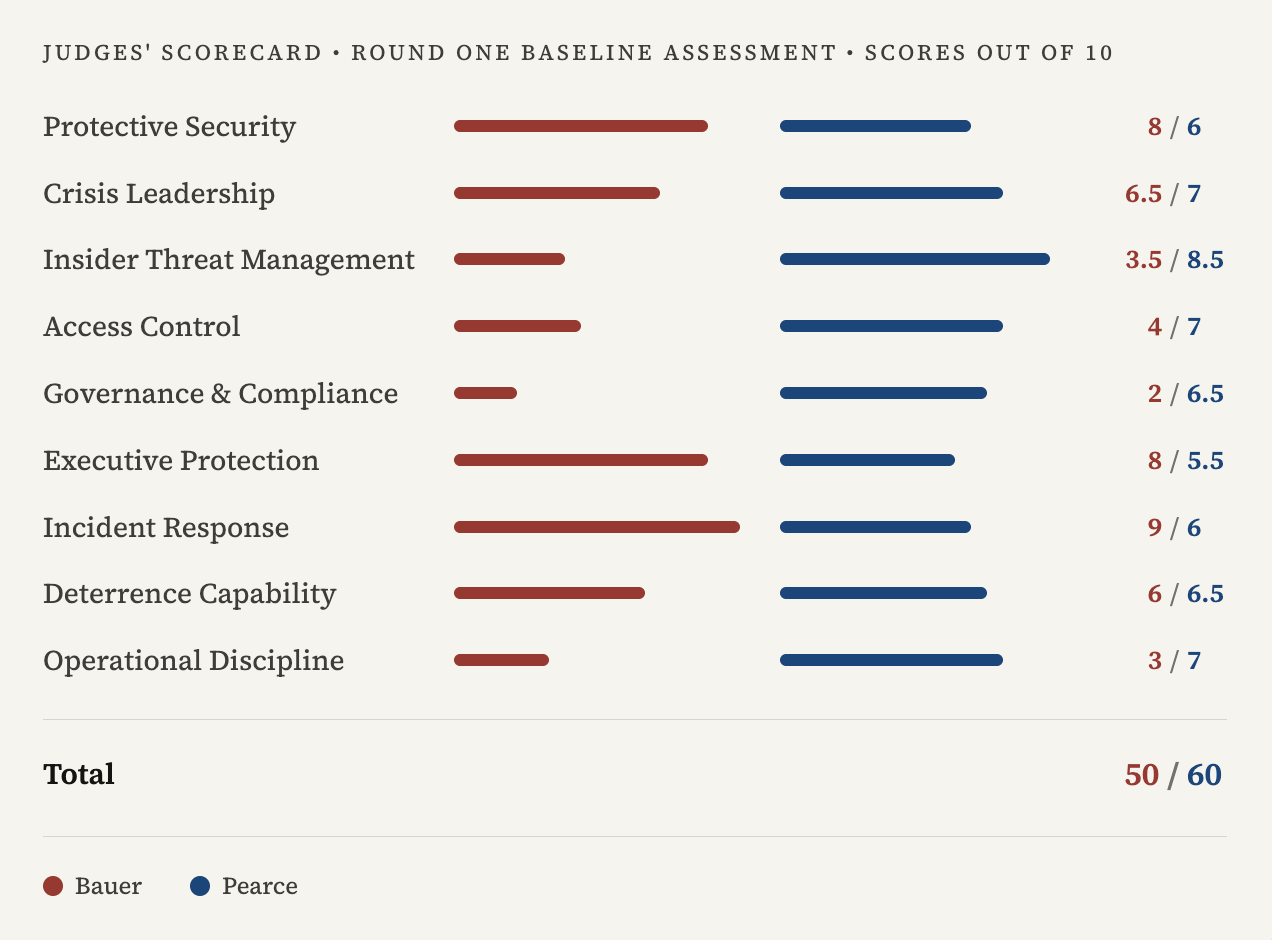
Advantage: Bauer. The clearest and least contestable finding in his favour anywhere in the match, though the panel notes that the gap here, three points, is smaller than the gap in either insider threat management or operational discipline, where Pearce's institutional advantage is more pronounced still.
Deterrence Capability
By the later years of his career, Bauer's reputation alone produces a measurable deterrent effect: adversaries who learn that Jack Bauer is involved in an operation adjust their planning accordingly, and some abandon their plans altogether. This is genuine deterrence, earned through a track record of near-supernatural personal effectiveness, though it is deterrence attached to an individual rather than an institution, and it offers no protection once Bauer is no longer the one adversaries are accounting for.
Pearce's deterrence is institutional rather than personal: the reputation of British intelligence capability broadly, the legal and operational reach of the service he represents, and the accumulated knowledge that the Grid's capacity for disruption does not depend on any single officer's continued involvement. This is a more durable form of deterrence, because it survives personnel changes, retirements, and the ordinary attrition of any long-running organisation.
Advantage: Pearce, narrowly, on durability. The panel notes that Bauer's personal deterrent effect, while real, is precisely the kind of asset that cannot be inherited by his successor.
Operational Discipline
Bauer possesses a form of personal discipline that is genuinely extraordinary: physical endurance, psychological resilience, and an absolute, unwavering commitment to the mission that does not waver regardless of personal cost. This is real and should not be dismissed. It is also not the same thing as operational discipline in the institutional sense, which requires consistent adherence to process, respect for the chain of command, and behaviour that can be relied upon by colleagues who are not Jack Bauer and do not have his particular tolerance for personal sacrifice. By that standard, his record is poor. He goes rogue habitually. He disregards direct orders when his own judgement disagrees with them. He treats the institution's rules as a starting point for negotiation rather than a constraint, and his colleagues have learned, across multiple seasons of bitter experience, that working with Bauer means accepting that the plan may be abandoned the moment he decides it should be.
Pearce's operational discipline is institutional in exactly the way Bauer's is not. He works through his service, builds and develops the people beneath him, maintains standards that persist when he is not personally present to enforce them, and has produced, across his tenure, a recognisable institutional culture at Section D that multiple generations of officers have inherited, internalised, and carried forward. This is precisely the programme transferability the panel identified as decisive in the previous match. Section D has survived Pearce's own absences, near-deaths, and eventual departure, because he built it to survive them. CTU has not demonstrated the equivalent capacity, and its leadership turnover, remarkable even by the standards of high-stress agencies, is itself a symptom of an institution that has organised itself around one extraordinary individual rather than building durable institutional capability around him.
Institutional attrition as a diagnostic signal: An organisation that burns through its formal leadership at an abnormal rate while one informal operator remains constant is exhibiting a specific and recognisable pathology. The instability is not random. It reflects an organisation whose actual locus of authority has migrated away from its nominal command structure and into the hands of whoever is capable of producing results outside it. This is comfortable in the short term, because the results keep arriving. It is corrosive in the long term, because the institution never develops the capability to produce those results without him, and every leader who tries to govern the gap between formal authority and actual authority eventually fails and is replaced. CTU's revolving directorship is not a coincidence. It is the data.
Advantage: Pearce, decisively, on the institutional measure that this discipline is ultimately meant to capture.
JUDGES' SCORECARD • ROUND ONE BASELINE ASSESSMENT • SCORES OUT OF 10
CTU has had more directors than most countries have had heads of state, and Jack Bauer has outlasted every single one of them. That is not a tribute to his loyalty. It is a diagnosis of his organisation.
The Broader Verdict
The panel wishes to state plainly what this result is and is not. It is not a finding that Jack Bauer is an inferior security professional to Harry Pearce in any tactical sense. His incident response and executive protection scores are among the highest this competition has awarded, and they are earned. Faced with a live, time-critical, catastrophic threat, there are very few candidates in this entire field the panel would rather have in the room.
It is a finding that the Chief Security Officer role this competition is assessing requires more than the ability to win the worst day of an organisation's existence. It requires the ability to build an organisation that does not need a saviour to survive its worst day, because it has already built the capability to handle it institutionally. CTU has never managed this. Across the entirety of Bauer's career, his organisation has remained dependent on his personal, repeated, rule-breaking intervention to prevent catastrophe, and it has paid for that dependency in leadership turnover, institutional instability, and a governance culture so thoroughly accustomed to exception-making that exception has effectively become the rule.
Section D, under Pearce, has its own scars, its own moles, and its own catalogue of morally compromising decisions. But it has also produced something CTU never has: officers who can run the operation when Pearce is unavailable, a counter-intelligence culture that catches threats before they detonate rather than resolving them after, and an institution that has demonstrably outlasted the near-destruction of its leadership on more than one occasion. This is what programme transferability looks like under sustained, realistic pressure rather than in the abstract.
Pearce advances. Bauer's tactical brilliance is not in question and will be missed in any scenario round that rewards immediate, high-stakes incident resolution. But this competition has settled, two matches running now, on a standard that values the institution over the individual hero, and Jack Bauer, for all that he has personally saved, has never built an institution capable of surviving without him.
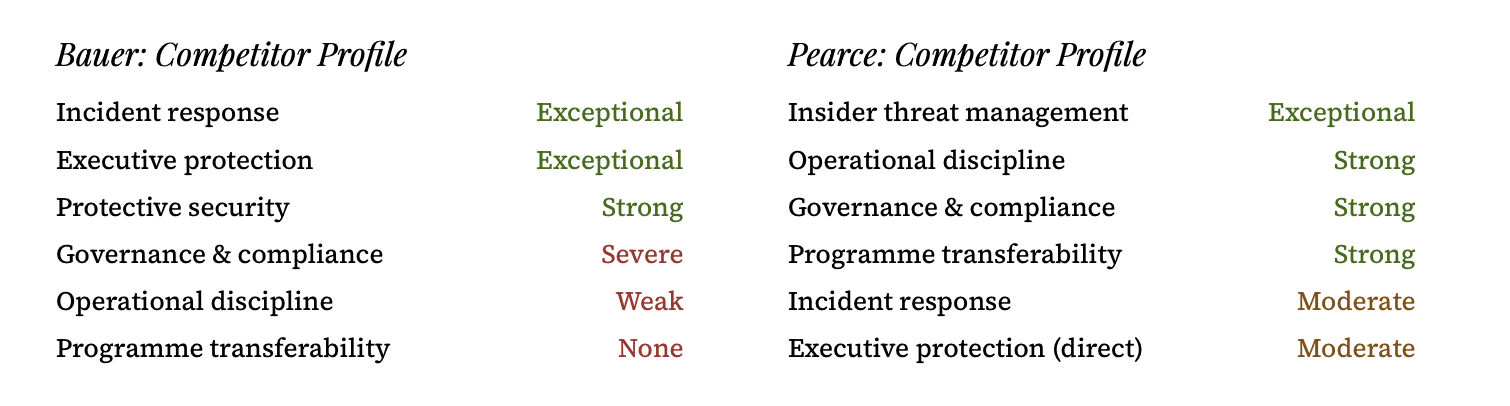
PANEL DECISION • ROUND ONE, MATCH SIX
🇬🇧 Harry Pearce advances 🇬🇧
By 60 points to 50. Pearce's dominance in insider threat management, governance, access control, and operational discipline outweighed Bauer's exceptional incident response and executive protection scores, the highest and second-highest single-category scores either candidate has recorded. The panel notes that Bauer's profile, like Drebin's and Woody's before him, would be formidable in scenario rounds built around acute, time-critical incident resolution. He does not advance to find out. CTU is respectfully invited to consider an exit interview, assuming it can locate a director who has held the position long enough to conduct one.
Next match in the World's Greatest CSO Competition: to be announced. The panel observes that the last two matches have established a consistent and now load-bearing standard: programme transferability and governance legitimacy decide close contests against opponents of superior tactical capability. The remaining Round One matchups will be assessed against this same standard. Candidates who have not yet been examined under it should not assume their tactical brilliance alone will carry them through.