

Match 7 - RoboCop VS The T-800
🏆 WORLD’S GREATEST CSO COMPETITION 🏆
ABOUT THE COMPETITION FORMAT
Round One assesses foundational leadership capability. This match presents the competition with its most direct test yet of the standard it has built across six previous matches: that governance legitimacy, programme transferability, and institutional judgment separate a Chief Security Officer from a security asset. Both candidates in this match are, by any conventional measure, security assets rather than security leaders. The panel's task is to determine whether either of them rises sufficiently above that description to merit a place in the quarter-finals.
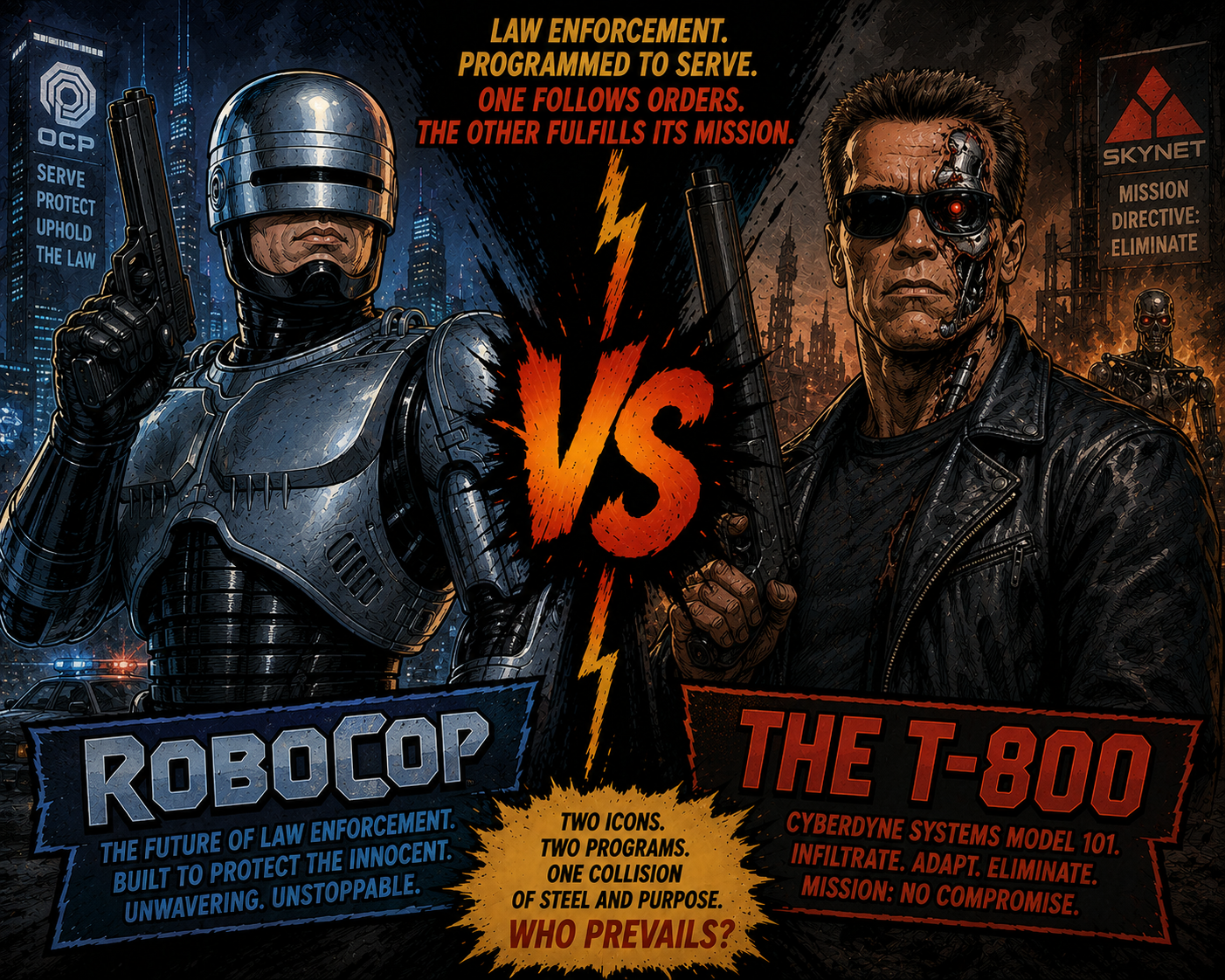
One is a police officer rebuilt as a machine, retaining just enough humanity to exercise judgement, honour a legal mandate, and grow beyond the programming his creators intended. The other is a machine that was sent from the future to protect a child, performed that function with near-perfect efficiency, and has absolutely no opinion about anything else. Both are cybernetic security assets of extraordinary physical capability. Only one of them is, in any meaningful sense, a security leader. The distinction is the match.
What This Match Is Really Testing
The competition has spent six matches progressively sharpening its understanding of what the CSO role requires. The standard it has settled on, governance legitimacy, programme transferability, the ability to build institutions rather than merely win incidents, was built to explain why tactically exceptional candidates with governance deficits lose to less dramatic candidates with sounder institutional foundations. Jack Bauer loses to Harry Pearce. Gus Fring loses to Man-at-Arms by one point. The individual hero loses to the institution builder.
This match is the reductio ad absurdum of that principle. The T-800 is security capability at its most optimised and its most narrow: a system of perfect execution, zero judgment, and complete absence of anything the competition's accumulated criteria value beyond the tactical. RoboCop is something more complicated: part machine, part human, part law enforcement officer, part corporate asset, operating within a legal framework he did not choose but has internalised, retaining the residue of a human conscience that his creators neither planned for nor, in some cases, wanted.
The question this match poses is not which candidate is more capable. It is which candidate is more of a Chief Security Officer. On the evidence, the answers to those questions are not the same.
Setting the Scene
RoboCop is Officer Alex Murphy of the Detroit Police Department, killed in the line of duty and reconstructed by Omni Consumer Products as a law enforcement cyborg. He operates under three prime directives: serve the public trust, protect the innocent, and uphold the law. A fourth directive, concealed from Murphy himself, prohibits him from arresting senior OCP executives. He has onboard threat assessment systems, a data link to police records, exceptional physical resilience, and a targeting accuracy that no human officer can match. He also has, surviving the reconstruction process in ways OCP did not fully anticipate, the personality, values, and fragmentary memories of Alex Murphy, which give him something none of his specifications required and none of his creators expected: the capacity for moral judgement that exceeds his programming.
The Terminator, Cyberdyne Systems Model 101, Series 800 Version 2.4, arrived in 1995 from 2029 with reprogrammed mission parameters: protect John Connor. Its physical capability is extraordinary, its threat assessment is instantaneous and accurate, its commitment to the mission is absolute, and its operational record in the protective role is, for the duration of its active deployment, essentially perfect. It cannot be reasoned with, cannot be deterred, and cannot be persuaded to deviate from its mission parameters. It is also incapable of setting those parameters itself, incapable of exercising judgment that the parameters do not require, and incapable of building, sustaining, or transferring any institutional capability whatsoever. It is, at its most precise, an objective with legs.
Protective Security
Both candidates possess protective security capabilities that dwarf every other competitor in this field. The question is not whether they can protect assets, but how they protect them and what that protection looks like in a broader organisational context.
RoboCop's protective security combines extraordinary physical capability with a genuine protective philosophy: the prime directives orient his entire function around public safety rather than merely principal survival. He protects individuals, communities, and the broader social environment. His protective security posture is preventive as well as reactive, visible as well as forceful, and grounded in legal authority that gives his protective actions a legitimacy that physical capability alone cannot confer. His onboard systems provide real-time threat assessment, and his resilience under fire allows him to sustain protective functions under conditions that would incapacitate or eliminate any human officer.
The T-800's protective security is, in the specific and narrow context of T2, extraordinary. It sustains protective function under conditions that include automatic weapons fire, explosive detonation, and a liquid metal adversary of superior technology. Its commitment to the protective mission is not a value or a choice. It is an operational parameter, which makes it more reliable in some respects and less meaningful in others. It protects John Connor with an effectiveness that no human or human-machine hybrid in this competition can match. It would protect anyone else with precisely the same intensity if that were its parameter, and with complete indifference if it were not.
Advantage: T-800, narrowly, on raw protective capability. RoboCop's broader protective orientation and legal grounding are significant assets, but in a direct protective security assessment the T-800's physical invulnerability and absolute mission commitment edge the category.
Crisis Leadership
RoboCop's crisis leadership is, within the constraints of his operating environment, genuine. He communicates with human officers, coordinates responses, provides information through his data link, and exercises judgment in the field that goes beyond mechanical execution of parameters. His residual humanity gives him something a pure machine cannot possess: the ability to read a situation through human as well as analytical eyes, to understand that the optimal tactical response may not be the optimal response for the people involved, and to adapt his behaviour in ways that his original programming would not have predicted. He does not lead in the way Pearce leads, building institutional capability across years of sustained mentorship. But he leads in the field, under pressure, in ways that produce better outcomes than a pure execution system would generate.
The T-800 does not lead. It cannot. Leadership requires the ability to assess a situation against a framework of values and judgement that goes beyond the immediate mission parameter, to communicate that assessment to others in ways that produce coordinated action, and to adapt based on the responses of the people around you. The T-800 assesses, acts, and protects. It does not communicate except instrumentally, does not coordinate except mechanically, and cannot adapt beyond the logical space of its mission parameters. In the crisis at Cyberdyne Systems, it manages the immediate protective task with perfect efficiency and then destroys approximately sixty police vehicles, because nothing in its operating parameters treats the collateral consequences of its actions as a relevant variable. This is not a crisis leadership failure. It is the complete absence of crisis leadership as a concept.
Advantage: RoboCop. The gap here is the second-largest in the match.
Insider Threat Management
This category exposes one of the most significant findings about RoboCop that any honest analysis of his candidacy must address. His Directive 4, the covert prohibition on arresting senior OCP executives, is an insider threat of extraordinary severity embedded directly into his own operating system. He was deployed as a law enforcement officer while containing, unknown to himself, a constraint that served the interests of his corporate creator rather than the public mandate his prime directives ostensibly represent. The discovery and eventual override of this directive is one of the most important moments in his operational record, because it demonstrates that his system can contain covert overrides that compromise its stated function without his knowledge or consent. This is insider threat operating at the architecture level rather than the personnel level, and it is a finding the panel treats seriously.
The embedded constraint problem: When a security system contains covert operational limits that serve interests other than those the system ostensibly protects, it is not merely a governance failure in the conventional sense. It is a systemic compromise of the security function itself. The organisation, community, or principal relying on that system operates under a false assumption about its scope and reliability. The danger is not merely that the constraint will be activated in a consequential moment, though it will be. The danger is that the existence of the constraint is unknown, which means it cannot be planned around, cannot be disclosed to relevant stakeholders, and cannot be corrected until the specific moment at which it becomes visible, which is precisely the moment it is already causing harm.
RoboCop's broader insider threat awareness, beyond the Directive 4 problem, is genuinely present and reflects his human residue. He understands human behaviour, recognises deception, and has demonstrated the capacity to identify corruption within institutions, including his own employer, through a combination of investigative capability and the moral instincts that survived his reconstruction. This is meaningful insider threat awareness. The Directive 4 finding prevents it from scoring as highly as it otherwise would.
The T-800 has no insider threat awareness. It does not understand the concept. It cannot recognise a mole, a compromised operator, or a covert corporate override, because its processing does not include any representation of human motivation, institutional loyalty, or the gap between what people claim to be and what they are. Its insider threat score reflects the complete absence of this capability rather than poor performance within it.
Advantage: RoboCop, despite the Directive 4 finding. Partial insider threat awareness, even compromised by a covert override, is more valuable than none.
Access Control
RoboCop's access control operates within a legal framework that gives it a legitimacy and a structure the T-800 cannot replicate. He challenges, identifies, and controls access through processes that are enforceable, auditable, and grounded in the law enforcement authority his prime directives establish. He does not merely prevent unauthorised access by force. He does so through a framework that recognises the distinction between the unauthorised and the merely suspicious, between the dangerous and the merely unwanted, and between the situations that warrant physical intervention and those that warrant something proportionately less severe.
The T-800's access control is absolute and entirely without nuance. Nothing enters a protected perimeter that the T-800 does not permit. The manner in which unauthorised access is denied is calibrated entirely to physical effectiveness rather than to proportionality, legal authority, or the interests of bystanders who happen to be in the vicinity. Its treatment of the Pescadero State Hospital as an access control environment during the escape sequence demonstrates the approach clearly: every security measure is overcome by the most direct available means, and the collateral consequences of doing so are not a variable in the calculation. This is access control as a physical fact rather than a governance practice.
Advantage: RoboCop, on the legal grounding and proportionality of his access control methodology. The T-800's absolute physical effectiveness is not in question. Its appropriateness as a model for organisational security practice is.
Governance and Compliance
RoboCop's governance profile is genuinely complicated, and the panel approaches it carefully. His prime directives constitute a governance framework of a specific and recognisable kind: a rules-based system that constrains his behaviour within defined parameters, creates accountability to a stated mission, and provides a basis for evaluating whether his actions are consistent with his function. "Serve the public trust, protect the innocent, uphold the law" is not a sophisticated governance framework in the way that Section D's relationship with the Home Secretary is. But it is a framework, it is grounded in legitimate legal authority, and it has shaped his conduct in ways that produce genuine accountability to a public mandate rather than merely to the interests of whoever is giving him orders.
The Directive 4 problem weighs against this. It demonstrates that his governance framework contains a covert layer that serves private corporate interests rather than public legal authority, which is precisely the kind of hidden governance deficit the competition identified as most dangerous in its assessment of Gus Fring. The difference is that RoboCop discovered and ultimately overrode this constraint through the exercise of the moral judgement his creators did not plan for. The endpoint of his governance story is a system that has broken free of a covert corporate override through the assertion of legal principle. That is a more encouraging governance trajectory than any other candidate with a comparable deficit has demonstrated.
The T-800's governance is the governance of a weapon. It serves whoever programmed it. In T2, that happens to be the future John Connor, who has programmed it to protect the present John Connor, which is a legitimate enough objective. In the original timeline, the same hardware was programmed to commit assassination. The governance of the T-800 is entirely dependent on the governance of whoever controls its programming, and it provides no independent constraint on that control whatsoever. It has no prime directives. It has no legal framework. It has no ethical architecture. It has mission parameters, and it executes them.
Advantage: RoboCop. A governance framework that contains a covert override which is eventually identified and overcome is preferable to the complete absence of any governance framework at all.
Executive Protection
This is the T-800's strongest category and, in T2, its entire function. The protection of John Connor across the film constitutes an executive protection record of extraordinary quality in purely operational terms. The principal is never harmed. Every threat is neutralised or evaded. The T-800 places itself physically between the principal and the threat on every occasion the threat presents itself, sustains that protective position under conditions of severe and sustained attack, and ultimately sacrifices itself to ensure the principal's long-term security rather than merely his immediate survival. In the narrow terms of keeping a specific principal alive against a specific threat, this is an elite record.
RoboCop's executive protection record is strong and consistent with his broader law enforcement mandate. He protects individuals, including persons in positions of authority and responsibility, with genuine dedication and considerable effectiveness. His legal framework and proportionality give his protection a structure that the T-800's approach lacks entirely. He enables the people he protects to continue functioning rather than becoming entirely dependent on his presence, which is the CSO-relevant dimension of executive protection that the T-800's model does not address.
Advantage: T-800, on the direct and narrow measure of principal survival under extreme threat. The panel acknowledges that the T2 executive protection scenario is the most demanding in the competition field, and the T-800's record within it is essentially without blemish.
Incident Response
Both candidates produce exceptional incident response outcomes, through mechanisms so different that comparing them requires care. RoboCop's incident response is immediate, proportionate, legally grounded, and produces outcomes that serve both the immediate security objective and the broader public interest. He applies force in ways that reflect genuine assessment of necessity rather than pure mission optimisation, which produces response outcomes that are both effective and defensible. His response times and decision quality under operational pressure are exceptional by any human standard and, given his onboard systems, exceptional even against automated benchmarks.
The T-800's incident response is immediate, total, and measured only against the criterion of mission success. Its effectiveness is beyond question. Its proportionality is not a consideration. The Cyberdyne Systems response sequence, in which it incapacitates an entire police deployment to enable escape with its principal, demonstrates this clearly: the incident is resolved, the principal is protected, and approximately half the law enforcement assets of Los Angeles are left in varying states of disrepair. No human life is lost, which the T-800 has been instructed to avoid. Every other consequence is irrelevant to its processing.
Advantage: Shared. Both candidates produce decisive and effective incident response outcomes. RoboCop's proportionality and legal grounding are genuine assets. The T-800's absolute effectiveness and resilience are equally genuine. The panel scores this category equal and moves on.
Deterrence Capability
RoboCop's deterrence in Detroit is documented and measurable. His presence on patrol reduces crime, his reputation precedes him into confrontations, and the knowledge that RoboCop is in the area changes adversarial behaviour before any incident occurs. This is deterrence working precisely as designed, and it is institutionally valuable because it represents a reduction in the security burden carried by human officers operating around him. He deters not merely through physical capability but through the combination of capability and legal authority, which produces a more durable deterrent effect than physical capability alone.
The T-800's deterrence capability is real but narrow. Adversaries who are aware of its presence and capabilities will avoid it. Adversaries who are not will encounter it without warning and without the benefit of prior deterrence. Its deterrence is entirely personal rather than institutional, entirely present rather than anticipatory, and entirely dependent on the adversary having accurate information about what they are facing. Against a sophisticated adversary with good intelligence, this produces powerful deterrence. Against one without it, deterrence never operates and response is the only available mechanism.
Advantage: RoboCop. His deterrence is broader, more sustainable, and institutionally embedded in a way that the T-800's purely personal deterrent effect is not.
Operational Discipline
The T-800's execution of its mission parameters is, within those parameters, perfect. It deviates from the parameters it has been given in no respect and under no pressure. This produces an operational consistency that no human or human-machine hybrid can replicate. It is also not operational discipline in any meaningful institutional sense. Operational discipline, as the competition has assessed it across seven matches, is the quality that sustains standards across an organisation, through personnel transitions, in the absence of direct supervision, and in situations the original parameters did not anticipate. The T-800 cannot do any of these things, because it has no parameters for doing them. Its consistency is the consistency of a machine executing a defined task, which is something rather different from the institutional discipline that makes security programmes transferable and durable.
Algorithmic governance and its limits: Rules-based security systems, whether embodied in programming or in procedural frameworks, offer significant advantages: consistency, predictability, resistance to corruption, and immunity from the personal lapses that human operators are subject to. They also carry a structural weakness that pure tactical capability conceals: they perform well within the parameters of the situations they were designed for and fail, sometimes catastrophically, in situations their designers did not anticipate. The T-800's mission parameters produce exceptional outcomes within a defined protective scenario. They offer no capability whatsoever outside it. An organisation that designs its security function entirely around algorithmic execution without preserving the capacity for human judgment has not created resilience. It has created a system that will perform perfectly until the day it encounters a situation nobody planned for, at which point it has no resources to draw on beyond the parameters that were always its only tool.
RoboCop's operational discipline is institutional rather than algorithmic. He follows his prime directives with consistency, but the prime directives themselves are broad enough to require interpretation, and the residual human judgment that survived his reconstruction does the interpreting. He maintains his standards under conditions his original programmers did not design for, because the moral framework that underpins those standards is genuinely his rather than merely imposed upon him. His operational discipline is transferable in a way the T-800's is not, because it is grounded in internalised values rather than parameterised instructions. Detroit's policing culture is different for his presence in ways that persist in the institutional environment he operates within.
Advantage: RoboCop, on the institutional measure the competition has come to treat as definitive.
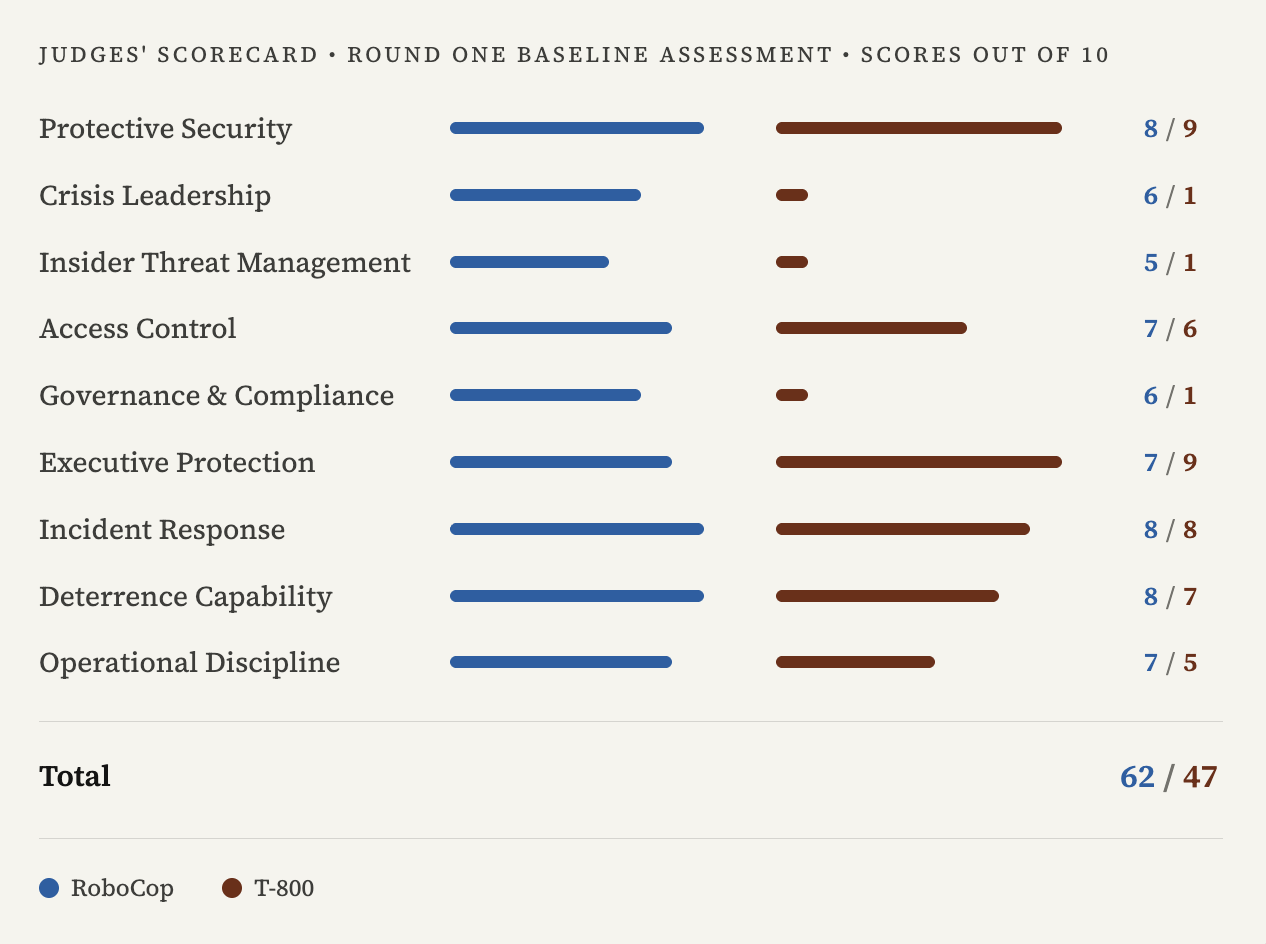
JUDGES' SCORECARD • ROUND ONE BASELINE ASSESSMENT • SCORES OUT OF 10
RoboCop has three prime directives, a human soul he did not choose to keep, and an employer he cannot fully trust. The T-800 has a mission parameter and the most reliable execution record in the competition. Between these two models of security lies the entire question of what the word 'leadership' actually means.
The Broader Verdict
The T-800's score of 47 is not, the panel wishes to note, a finding that it is a poor security asset. In three individual categories, it scores 8 or above. Its executive protection record in T2 is the finest single-role performance in the competition field. Its incident response is devastating and reliable. Its protective capability exceeds that of almost every other candidate in purely physical terms. As a security asset, it is exceptional. As a Chief Security Officer, it is not even a candidate.
The score of 1 in crisis leadership, insider threat management, and governance is not a rhetorical gesture. It reflects a genuine finding: that the T-800 has no capability in these categories in any institutional sense, not poor capability, not developing capability, not capability constrained by circumstance, but the literal absence of the concept. It does not lead. It does not understand insider threat as a phenomenon. It has no governance framework. These are not weaknesses to be managed. They are the definition of an asset rather than a leader, a tool rather than a practitioner, and a weapon rather than an officer.
RoboCop is not a perfect Chief Security Officer, and the panel does not advance him as one. The Directive 4 problem is a serious finding about the trustworthiness of his governance architecture. His institutional building capacity is limited by the nature of what he is. His operational environment, a corporation-controlled police force in a dystopian near-future, is not the governance ideal the competition has been working towards. But he is, on the evidence, a security leader rather than merely a security asset. He has values, not just parameters. He has judgment, not just threat assessment. He has a legal framework he has chosen to uphold, not merely a mission he was built to execute. And he has, in the moments that mattered, overridden his own corrupted programming through the exercise of the conscience his creators did not plan for. That is, in its way, the most impressive governance record in the competition.
RoboCop advances. The T-800 is thanked for its participation and advised that the panel's decision is final, which it will accept, because it has been given no parameters to the contrary.
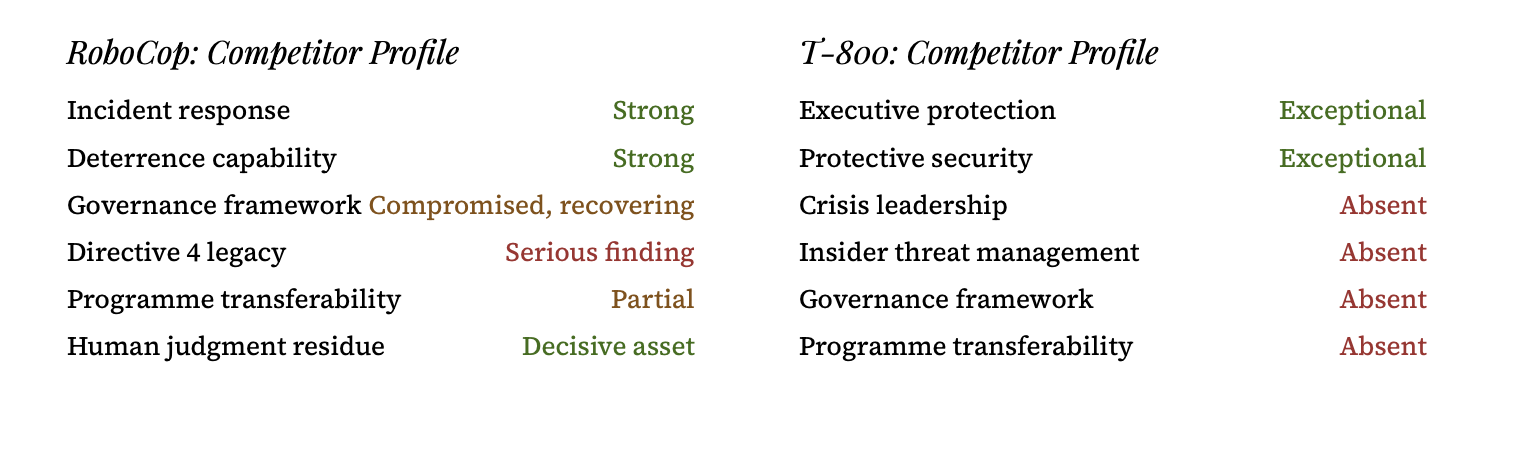
PANEL DECISION • ROUND ONE, MATCH SEVEN
RoboCop advances
By 62 points to 47. RoboCop's governance framework, crisis leadership, insider threat awareness, deterrence capability, and operational discipline provided a decisive margin over the T-800's exceptional but institutionally narrow protective security and executive protection scores. The panel notes that the T-800's score of 47 is entirely composed of genuine capability in the categories it actually possesses. It scores 1 in three categories not because it performs poorly in them, but because it does not perform in them at all. This is not a finding about quality. It is a finding about scope. And scope, in the CSO role, is the job.
Next match in the World's Greatest CSO Competition: to be announced. The panel notes that seven matches into Round One, the advancing field is taking shape. The competition's standard, governance legitimacy and programme transferability over tactical brilliance, has held across every match in which it was genuinely tested. It will be tested more severely still in the quarter-finals, where operational scenarios will introduce the specific, concrete contexts in which some of the advancing candidates' professed governance qualities will either hold or reveal themselves as theoretical rather than practical. The panel is watching the bracket with considerable interest.