

Match 5 - Duncan, Man-at-Arms VS Gustavo Fring
🏆 WORLD’S GREATEST CSO COMPETITION 🏆
ABOUT THE COMPETITION FORMAT
Round One focuses on foundational leadership capability. This match requires the panel to address a prior question before the scorecard is reached: what does the Chief Security Officer role fundamentally require? The panel's position, reached after the closest analytical deliberation of Round One, is that the role requires not merely technical security capability but governance legitimacy, organisational development, and the ability to build programme resilience that outlasts any individual. These are not peripheral qualities. They are the qualities that distinguish a CSO from a security operator. This framing shapes every score in the match.

One builds castles. The other builds ecosystems. One believes security should be visible, its deterrence felt, its capability understood. The other believes the safest operation is the one nobody realises exists. Both approaches have genuine merit. Only one produces what a Chief Security Officer is actually employed to create: an organisation that can protect itself, develop its people, sustain its standards, and endure beyond the tenure of the person who built it.
The Question This Match Finally Forces
Five matches into Round One, the competition has consistently rewarded technical security capability while recording governance failures as a scored category rather than a disqualifying condition. Vader's governance score was 1. Dredd's was 4. Both advanced. The panel has operated on the principle that capability and legitimacy are separable analytical categories, and that an honest competition assesses the former while recording the latter.
This match forces a reconsideration. Not because the panel has changed its mind about analytical honesty, but because Gus Fring's candidacy presents a case in which the technical capability and the governance failure are not separable. His security programme is exceptional precisely because it is criminal. The compartmentalisation, the cover infrastructure, the information control, the operational secrecy, the personal concentration of all critical knowledge and authority in a single individual with no succession plan and no accountability mechanism: these are not incidental features of a CSO who happens to be running a criminal enterprise. They are design features of a criminal enterprise that happens to employ security techniques.
The panel has therefore asked a more precise question of this match than it has asked of previous ones. Not who has the stronger security capability in isolation, but who is the stronger Chief Security Officer, where that role is understood to require governance legitimacy, institutional development, programme transferability, and the creation of security cultures that enable organisations to thrive. By this definition, the match is genuinely close. It is also, finally, clear.
Setting the Scene
Duncan, Man-at-Arms, is Royal Weapons Master and principal security advisor to the House of Eternia. He is a military commander of long experience, an engineer of genuine originality, a trainer of personnel, and a builder of security systems designed to function whether or not he is present to operate them. He approaches security as an engineer approaches a complex structure: his instinct is to strengthen systems, identify weaknesses, develop capability, and create environments where intelligent adversaries encounter resistance they cannot predict or circumvent. He is not merely a soldier. He is an organiser, a developer, and an institution-builder. The distinction matters more than it might initially appear.
Gustavo Fring is the owner of a regional fast food franchise of impeccable reputation and the operational architect of a drug distribution network of extraordinary sophistication. His entire operating model rests on compartmentalisation, information control, operational secrecy, behavioural discipline, and meticulous planning. He creates environments where individuals know only what they need to know, exposure is minimised, risk is distributed, and failure points are isolated. From a purely technical security perspective, this is among the most sophisticated approaches in the competition field. It is also, in its entirety, a criminal enterprise whose governance structure consists of one man's personal oversight of a programme nobody else fully understands and nobody legitimate has sanctioned.
Protective Security
Gus's protective security is technically exceptional, and the panel acknowledges this without reservation. His primary innovation, the use of legitimate commercial infrastructure as a protective layer in its own right, is genuinely original. Los Pollos Hermanos does not merely provide cover. It provides the social and institutional assumption of innocence, which is a protective security asset more durable than any physical barrier for as long as it holds. His physical security for the production operation is correspondingly sophisticated: physically inaccessible, layered, operationally disciplined, and maintained to a standard that conventional enforcement cannot penetrate through conventional means.
Man-at-Arms' protective security is built on a different and equally ancient philosophy: that visible protection deters attack, that potential adversaries should understand hostile action will encounter serious resistance, and that the most important security investment is in trained people and reinforced systems rather than concealment. Many modern critical infrastructure operators depend on precisely this model. A visible, professional security presence prevents incidents that never appear in any after-action report because they never occur. Man-at-Arms understands this instinctively, and the systems he builds reflect it. His record against conventional threats is strong. His record against Skeletor's supernatural capability is the record of a man whose systems were correctly designed for conventional threats and who compensated appropriately for the unconventional ones.
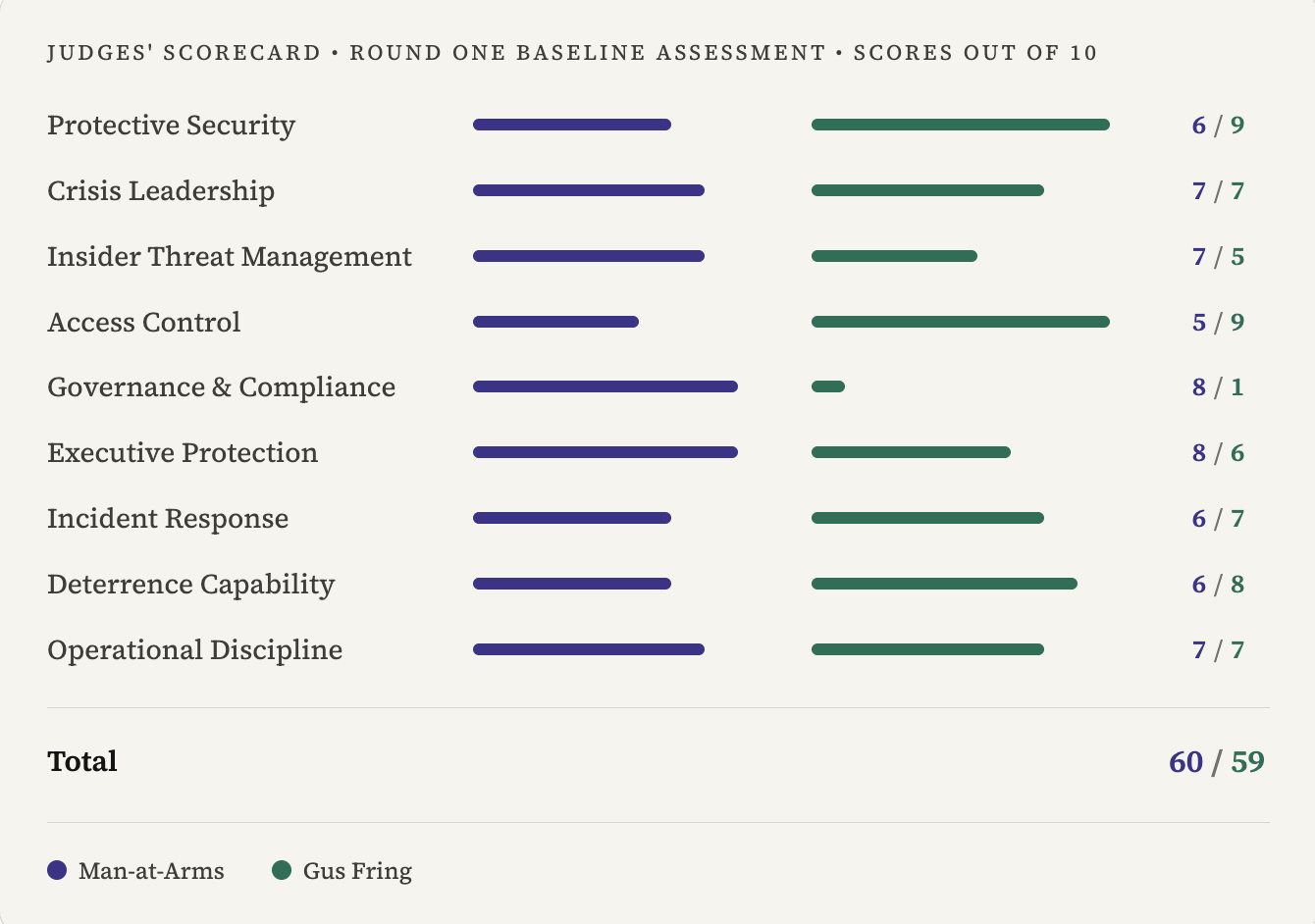
Advantage: Gus. His protective security is more technically sophisticated and performs more consistently against its actual threat environment. The panel awards this category clearly while noting that visible deterrence is not the inferior philosophy Gus's advocates sometimes imply.
Crisis Leadership
Man-at-Arms is visible in a crisis. He coordinates, communicates, inspires, and stabilises. He projects the calm confidence of an experienced military commander, and his presence during acute incidents has a material effect on the performance of the people around him. He is not merely managing the incident. He is managing the people managing the incident, which is the more important task and the more demanding one. Modern crisis leadership increasingly requires leaders to be seen, heard, and understood by the stakeholders they are reassuring and the teams they are directing. Man-at-Arms fulfils this requirement without effort because it is the leadership mode he was trained for and that his character naturally produces.
Gus's crisis leadership is formidable in a specific and narrow sense. His composure under extreme personal threat is extraordinary. His strategic patience, exemplified by a years-long methodical preparation for the elimination of a major criminal threat, represents a crisis management capability that no candidate in this competition can match for sheer disciplined execution. He rarely appears surprised. He rarely appears frightened. He solves problems before they become crises, through mechanisms he has prepared in advance, with a cold precision that is operationally impressive and humanly unsettling.
The limitation is equally specific. Gus resolves crises without discussing them. His executives, to the extent the term applies, are managed rather than informed. His stakeholders are kept comfortable through concealment rather than communication. A CSO who solves problems invisibly may produce good outcomes in the short term. Over time, stakeholders who are managed rather than trusted develop the kind of passive dependency that collapses under genuine pressure. Man-at-Arms builds crisis capability in his people. Gus concentrates it in himself.
Advantage: Shared. This is one of two drawn categories in the match. Both candidates perform to a high standard by entirely different mechanisms, and the panel declines to rank one above the other.
Insider Threat Management
Man-at-Arms holds the most consequential insider secret in the competition: that Prince Adam and He-Man are the same person. His management of this confidence, over an extended period, under conditions where disclosure would have been personally convenient on multiple occasions, represents insider threat discretion of a genuinely high order. Beyond this, his approach to insider threat rests on what it should rest on: deep knowledge of his people, genuine relationships maintained over time, and the kind of behavioural awareness that develops through trust rather than surveillance. He knows when something is wrong with someone before the official indicators emerge, because he knows them well enough to notice the difference.
Gus's insider threat management operates through the opposite philosophy. Trust is never absolute. Information is compartmentalised. Access is restricted by design. He builds systems that assume human unreliability rather than building cultures that reduce it. For most of his operational career, this produces exceptional results. His vetting is rigorous, his monitoring is systematic, and his response to identified threats is decisive. The difficulty is that his system, however well designed, cannot detect a threat that does not yet exist. Walter White's insider threat did not emerge at vetting. It developed in response to conditions that arose later: ego, pride, and a growing conviction that the relationship was exploitative. No vetting process reliably catches this category of threat. The response when it emerges is to identify the deterioration early and act on it. Gus failed to act on the deterioration until it was irreversible, and the consequence was fatal. He was not merely unsuccessful at managing an insider threat. He was killed by one.
Advantage: Man-at-Arms. His record is consistent, his discretion is exemplary, and his trust-based awareness catches what surveillance misses. Gus's superior technical infrastructure is outweighed by the terminal consequence of his most significant insider threat failure.
Access Control
These two candidates represent two enduring schools of security thought, and this category is where the philosophical divide is sharpest. Man-at-Arms asks: how do we stop unauthorised access? He builds walls, trains guards, establishes challenge procedures, and layers physical controls to make penetration as difficult as possible. Gus asks: how do we ensure nobody knows what to access in the first place? He builds cover, controls information, restricts knowledge of the asset's existence, and makes the question of access largely irrelevant by making the asset invisible.
Both approaches have genuine merit, and the strongest security programmes combine elements of each. In terms of raw access control performance against the actual threats each candidate faces, Gus's model is more consistently effective. His laboratory is inaccessible to conventional investigation for years. His operational infrastructure is penetrated only when his cover identity is compromised, at which point the access control fails with it, but the failure is of the cover rather than the controls themselves.
Man-at-Arms' access controls are tested more directly and more regularly by adversaries with supernatural means of circumvention. His compensating control for threats his physical systems cannot stop is the He-Man capability, which is effective but introduces a structural dependency the panel addresses in the operational discipline section.
Advantage: Gus. His access control model is more technically sophisticated and more consistently effective against its actual threat environment.
Governance and Compliance
Man-at-Arms operates within one of the most genuinely legitimate governance frameworks in the competition. He serves the Royal House of Eternia under a defined mandate, reports through established chain of command to King Randor, and exercises his security function within a structure of royal accountability that provides genuine external oversight of his activities. His security programme serves the interests of the kingdom, not his own. His governance is honest, his accountability is real, and his decisions are subject to review by legitimate authority. He is a trusted advisor in the fullest sense: trusted because the trust has been earned, and because the mechanisms for withdrawing it exist and would be used.
Gus Fring's governance posture requires the panel to address two distinct and compounding failures. The first is familiar: his entire enterprise is criminal, his compliance obligations are self-defined, and his accountability structures answer to no legitimate authority. The second has received insufficient attention in this competition and is, in many respects, the more instructive failure for security practitioners. Gus does not distribute authority. He concentrates it. He delegates tasks but retains all critical knowledge, all strategic decision-making, and all programme visibility in his own person. His operation has no succession capability, no distributed leadership, and no organisational memory beyond what exists in his own mind.
The concentrated authority failure: A security programme whose critical knowledge and strategic capability reside entirely in one individual is not a resilient programme. It is a person with a job title. When that person is unavailable, compromised, or, as in Gus's case, eliminated, the programme does not continue in degraded form. It ceases to exist. This is the governance failure that sits beneath the criminal enterprise failure and would be just as consequential in a legitimate organisation. A CSO who builds a programme that cannot survive their departure has not built a programme. They have built a dependency. Man-at-Arms builds programmes. Gus builds dependencies.
Advantage: Man-at-Arms, by the widest margin in the match. His governance is genuine on both dimensions: legitimate in authority and distributed in structure. Gus fails on both.
Executive Protection
Executives and the principals of secure organisations rarely seek the most powerful protector. They seek the person who allows them to function effectively while managing the risks that attend their role. This distinction, between protection that enables and protection that constrains, is one of the most practical in executive security, and it is one that Man-at-Arms understands from long experience.
His protective philosophy is explicitly facilitative: security exists to enable King Randor and the royal family to exercise their authority, not to substitute for it. He plans for the principal's needs, not merely the threat. He maintains protective arrangements that are proportionate, professional, and designed around allowing the people he protects to lead effectively rather than hiding them from the risks of doing so. He accepts, with the equanimity of a professional who understands the distinction between security function and security theatre, that his role is to reduce risk rather than eliminate it, and that eliminating it would require preventing the very activities that make the protection worthwhile.
Gus protects himself with exceptional skill and his operational assets with systematic rigour. His protection of others is managed through concealment and control, which provides security but not confidence. Stakeholders who are secure but not informed, protected but not trusted, tend to develop the kind of anxious passivity that becomes a vulnerability in its own right. Confidence is itself a strategic asset, and Gus's protective model systematically withholds it.
Advantage: Man-at-Arms. He enables his principals. Gus manages his.
Incident Response
Gus's approach to incident response is, technically speaking, superior. He does not respond to incidents if he can help it. He resolves them before they occur, through mechanisms he has prepared in advance, at a time of his own choosing. His management of the Cartel threat, a multi-year strategic programme executed with extraordinary precision, represents an incident resolution capability that most security professionals can barely conceptualise, let alone replicate. When he does respond to active incidents, his composure and decisiveness are without peer in the competition field.
Man-at-Arms' incident response is solid, experienced, and structurally sound. He mobilises available resources, provides strategic direction, coordinates the defensive response, and performs his supporting role in acute incidents with professionalism and without resentment. His limitation is genuine: in Eternia's most serious incidents, the primary operational response belongs to He-Man rather than Man-at-Arms, and this structural feature of his role reduces his direct incident response effectiveness relative to what his experience and capability might otherwise produce.
Advantage: Gus. His pre-emptive resolution model is genuinely exceptional. The panel notes that the one incident he failed to resolve before it resolved him is the most consequential data point in the category.
Deterrence Capability
Man-at-Arms' deterrence rests on visible capability: the royal guard, the defensive architecture of the palace, the weapons systems he has designed and built, and the knowledge that any hostile action against Eternia will encounter serious, professionally organised resistance. This is deterrence through presence, through demonstrated readiness, and through the clear communication that attack carries significant cost. It works well against rational adversaries who calculate expected outcomes. It does not work well against Skeletor, who has at various points concluded that the expected cost is worth bearing, but Skeletor represents an adversary category that no deterrence framework based on conventional cost-benefit calculation was ever designed to address.
Gus's deterrence operates through an entirely different register: reputation within a specific community combined with the complete invisibility of that reputation to everyone outside it. Within his criminal network, the certain knowledge that crossing Gus produces consequences, delivered patiently and precisely, is a deterrence of remarkable effectiveness. Against broader institutional scrutiny, his deterrence is the deterrence of a man who appears to be exactly what he is pretending to be, which is the most complete form of deterrence available to someone in his position.
Advantage: Gus. His deterrence capability is more sophisticated and more specifically calibrated to his actual threat environment.
Operational Discipline
This category requires the most careful treatment in the match, because both candidates score highly and the distinction between them is a matter of kind rather than degree.
Gus's personal operational discipline is extraordinary. Every aspect of his operation runs to a standard of precision that admits no deviation and tolerates no exception. His personnel follow protocols exactly. His timelines are maintained with Swiss-watch regularity. His own personal conduct, in every environment and under every level of scrutiny, produces no exploitable pattern and no behavioural anomaly. He is, as an individual operator, as disciplined as anyone in this competition.
What he does not do is build operational discipline into the organisation. His discipline is his own. It is present because he is present. When the protocols are followed, they are followed because Gus requires it, not because the people following them have internalised why the standard exists and what happens when it is abandoned. His programme is precisely as disciplined as he is personally available to make it, which means it is extraordinarily disciplined right up until the moment it collapses entirely.
Programme transferability as a CSO criterion: Weak security organisations depend upon individual heroes. Strong ones depend upon repeatable capability. The test of a security programme's operational discipline is not how well it performs when its leader is present and functioning, but how well it performs when they are not. A leader who creates disciplined teams has built something that will outlast them. A leader who embodies discipline personally has created a dependency that will not. Man-at-Arms trains, develops, and institutionalises. His security capability is embedded in the organisation rather than in himself. This is what mature security leadership looks like, and it is the quality that most decisively separates him from Gus when the CSO role is understood in its full organisational context.
Man-at-Arms' operational discipline is less personally spectacular than Gus's and considerably more valuable. He maintains his own standards with military consistency while simultaneously building those standards into the teams and systems around him. His operational discipline is transferable. It exists independently of his presence. It will continue when he is absent, injured, or replaced. This is not a minor administrative virtue. It is the fundamental difference between a security professional and a security institution.
Advantage: Shared. The panel scores both candidates at seven, reflecting Gus's extraordinary personal precision and Man-at-Arms' superior institutional embedding. The distinction between them is not captured in the score. It is captured in the concept above.
JUDGES' SCORECARD • ROUND ONE BASELINE ASSESSMENT • SCORES OUT OF 10
Gus Fring is an exceptional security operator. Man-at-Arms is an exceptional security leader. In a competition for Chief Security Officer, the distinction is the competition. Castles may eventually fall. Secret empires may eventually collapse. Well-trained people operating within strong, legitimate institutions can adapt, recover, and endure. That is the more powerful form of security, and it is the one this competition exists to identify.
The Broader Verdict
The panel wishes to be transparent about the scoring. Gus Fring wins six of nine individual discipline categories. He loses the match by a single point. This outcome is not a distortion of the scorecard. It is its honest product, once the governance category is scored to reflect both the criminal enterprise failure and the concentrated authority failure that sit beneath it, once executive protection is scored to reflect the enabling dimension of the role rather than merely its protective one, and once crisis leadership is scored to reflect the full requirement for stakeholder communication rather than merely operational resolution.
Gus's governance score of 1 reflects a compounded finding. It is not merely that his enterprise is criminal, though that alone would justify a very low score. It is that his programme is also personally concentrated to a degree that renders it fragile by design. He does not distribute authority. He does not build succession capability. He does not create the kind of institutional resilience that allows a security programme to survive the departure, compromise, or, as it transpired, elimination of the person who built it. A criminal enterprise and a single point of failure: both findings belong in the governance score, and together they produce the number that decides the match.
Man-at-Arms advances not because he outperforms Gus in most categories, which he does not. He advances because the purpose of security leadership is not simply to protect assets but to help people and organisations thrive despite uncertainty. That requires building capability in others, not concentrating it in oneself. It requires governance structures that answer to legitimate authority. It requires programme designs that outlast the programme's designer. It requires, in short, the qualities that Man-at-Arms has spent a career developing and that Gus's extraordinary personal capabilities have made unnecessary for him to consider.
The panel notes that Gus Fring would have won this competition under a different definition of the role it is assessing. That definition exists, and there are contexts in which it would be the right one. This competition is not assessing those contexts. It is assessing Chief Security Officers. Man-at-Arms is one. Gus Fring is not.
PANEL DECISION • ROUND ONE, MATCH FIVE
Man-at-Arms advances
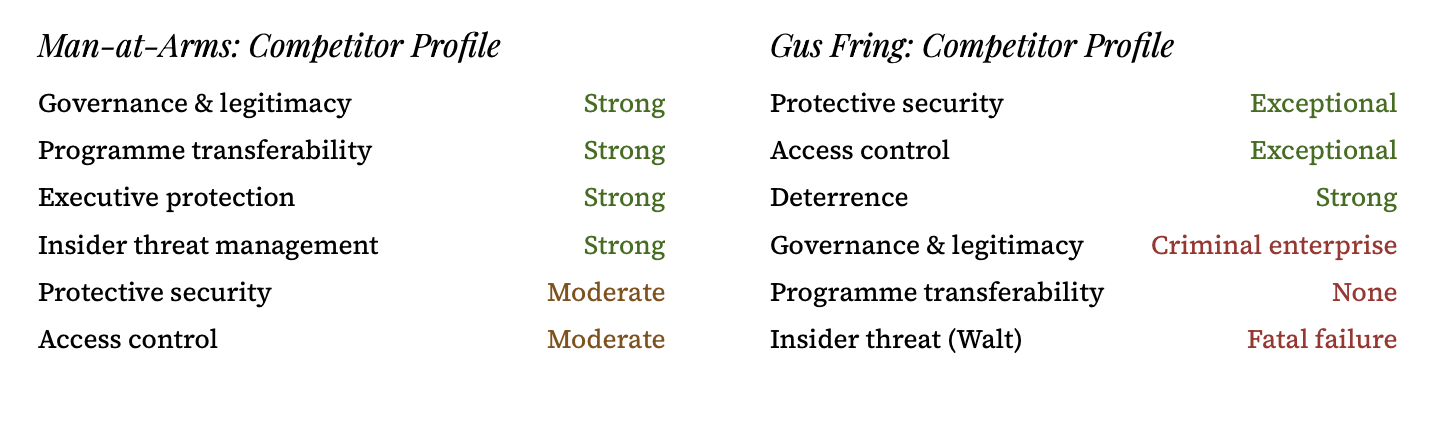
By 60 points to 59, the narrowest result in Round One. Man-at-Arms' governance, programme transferability, executive protection, and insider threat management provided a one-point margin over Gus Fring's exceptional performance in protective security, access control, deterrence, and incident response. The panel records that Gus Fring is a technically outstanding security operator who loses this match not because his capabilities are insufficient but because a Chief Security Officer requires more than capability. Gus exits the competition. Quietly, without expression, and through a door nobody else knew existed.
Next match in the World's Greatest CSO Competition: to be announced. The panel notes that this match has produced the competition's most important analytical finding to date: that security capability and security leadership are not the same thing, and that this competition is assessing the latter. This distinction will shape every remaining match, every quarter-final scenario, and ultimately the identification of the world's greatest Chief Security Officer. The panel is now rather more certain about what it is looking for.