

Match 4 - Jonathan Quayle Higgins III VS Sheriff Woody Pride
🏆 WORLD’S GREATEST CSO COMPETITION 🏆
ABOUT THE COMPETITION FORMAT
Round One focuses on foundational leadership capability: leadership philosophy, governance maturity, operational style, and organisational culture. These baseline assessments establish each contestant's profile before scenario-based operational challenges begin in the quarter-finals. A strong foundational showing here reflects genuine institutional competence. It does not, the panel has noted across three previous matches, guarantee either operational effectiveness or eventual tournament progress.

One is a former British Army Regimental Sergeant-Major, security administrator of a prestigious Hawaiian estate, keeper of meticulous dossiers, and commander of two Doberman Pinschers whose professional record is frankly superior to most of the candidates in this competition. The other is a pull-string cowboy toy, approximately eleven inches tall, with no formal security training, no institutional authority, no physical deterrence capability worth mentioning, and an operational record that includes successfully evacuating a community from a burning incinerator. The panel did not expect this match to be as close as it is. It is closer than it has any right to be.
The Two Questions This Matchup Poses
This matchup invites two analytical frames, both of which are necessary for a complete account of what separates these candidates.
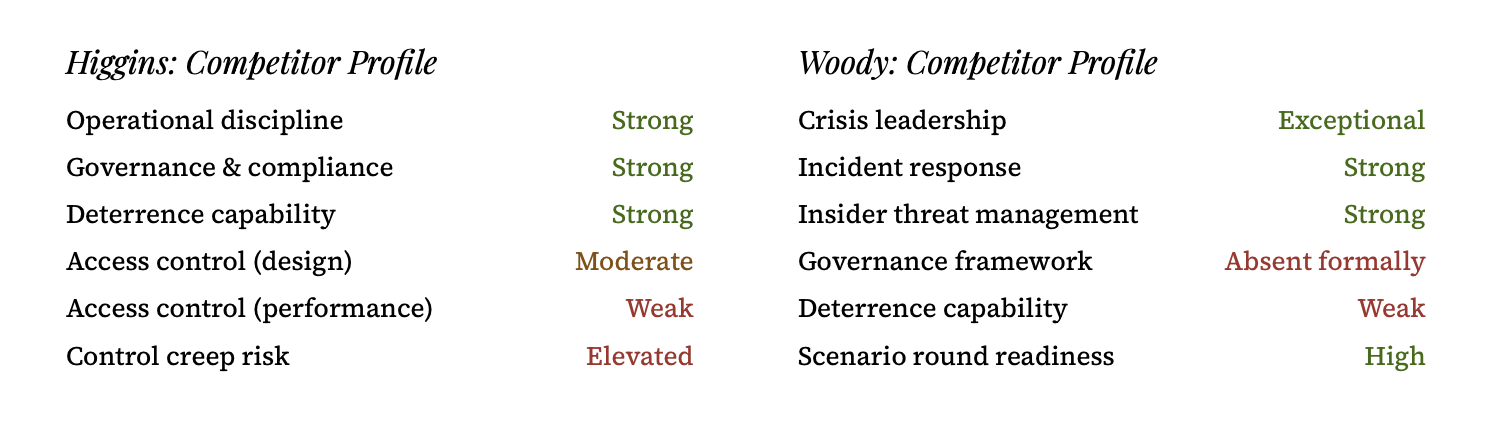
The first is the credentials-outcomes gap: the uncomfortable and persistent distance between a security programme's designed performance and its actual one. Jonathan Higgins illustrates this gap with an involuntary precision that the panel finds both instructive and quietly painful. His security apparatus is impressive. Its performance against the one persistent, predictable actor it most frequently faces is not.
The second, and more fundamental, frame is the question of what security is actually built from. Is it primarily created through control? Or through trust? Higgins and Woody represent genuinely different answers to this question. Higgins' entire operating philosophy is built on the proposition that security is achieved through structure, verification, and disciplined enforcement of boundaries. Woody's operating philosophy, to the extent that it can be formally described, is built on the proposition that security emerges from relationships, shared purpose, and the voluntary commitment of people who believe in what they are protecting. These are not incompatible positions. They are, however, positions that produce very different organisations, very different cultures, and, under pressure, very different outcomes.
The panel notes that this is the first match in the competition in which both candidates are, in their own ways, admirable. Neither is corrupt, neither is negligent, and neither would be immediately disqualifying in a real security leadership role. The question is simply which foundational profile better serves the demands of a modern Chief Security Officer.
Setting the Scene
Jonathan Higgins manages Robin's Nest, the Hawaiian estate of the wealthy and conspicuously absent Robin Masters, with the exacting standards of a man who has carried British military discipline into civilian life and applied it without reservation to every aspect of his professional existence. He maintains extensive intelligence files on persons of interest. He conducts perimeter assessments with genuine rigour. He has designed and operates a physical security system built around prevention rather than reaction: his instinct is to stop threats before they materialise rather than to respond after they have. He has Zeus and Apollo, his Dobermans, whose professional competence is, as noted above, above average for the competition field. He takes his responsibilities with complete seriousness, documents everything, and holds himself to a standard that most security professionals would privately find exhausting.
His operating environment contains one variable that his security design has never successfully accommodated: Thomas Magnum, private investigator, resident of the guest cottage, and persistent, recurring, essentially unresolvable breach of every access control measure Higgins has ever implemented. The panel returns to this point throughout the article, because it is central to an honest assessment of Higgins' record.
Sheriff Woody Pride is the de facto security and community leader of a succession of toy communities across four films of escalating operational complexity. He has no physical coercive capability, no formal mandate, no institutional backing, and no budget. His authority derives entirely from the trust of those he leads, the clarity of his values, and a track record of getting his community through situations that should, by any rational assessment, have been unsurvivable. He has faced an incinerator, a villainous plush bear running a daycare facility as a coercive detention operation, and the existential crisis of a child growing up, and has emerged from each with his community intact and his integrity undamaged.
Protective Security
Higgins' protective security posture is, in design terms, among the most coherent in the competition field. He maintains a defined perimeter, applies challenge procedures with consistency, employs layered physical controls, and has positioned Zeus and Apollo as a rapid-response capability that is, within the bounds of their operational environment, genuinely effective. His protective philosophy is deliberately preventive: he understands that effective security depends not upon dramatic interventions but upon hundreds of small controls operating consistently over time. Visitor management, key control, boundary definition, asset accountability, and challenge procedures are not glamorous topics, but they are frequently the difference between an incident that occurs and one that does not. Higgins grasps this instinctively, and his operating model reflects it in ways that many more technically sophisticated security programmes do not.
The difficulty is the gap between the posture and its performance. Robin's Nest is breached with a regularity that no honest after-action review could describe as acceptable. Magnum, whose circumvention of Higgins' controls has become so routine that it functions as an unacknowledged feature of the estate's daily operations, represents a sustained access failure that Higgins has been unable to resolve despite years of awareness. This is not a trivial finding. A protective security posture that cannot prevent a known, persistent, and entirely predictable actor from entering at will is not performing to its design standard, regardless of how impressive that standard appears on paper.
Woody's protective security operates through entirely different mechanisms. Without physical deterrence capability of any conventional kind, he relies on situational awareness, early warning through his network, creative compensating controls, and the ability to mobilise his community rapidly when a threat is identified. He has protected his community against threats that included purposeful human children, malicious actors, and the various hazards of the physical environment, consistently and without the resources that professional security operations take for granted.
Advantage: Higgins, on design quality and intent. The panel notes that the margin is considerably narrower than the disparity in resources should permit.
Crisis Leadership
This is where the matchup shifts decisively, and where Woody's candidacy becomes not merely interesting but compelling.
Higgins' crisis leadership is competent within a defined range of scenarios. He is calm, he communicates clearly, and he draws on genuine military experience in a way that produces structured responses to structured threats. His limitations emerge when events deviate from his mental model of how a crisis should unfold, which real crises have a consistent tendency to do. He has a preference for procedure at moments that call for creative judgement, and a slight but consistent difficulty with the admission that the situation requires something he has not prepared for. These are recognisable features of a security leader whose training has been excellent and whose operational environment has occasionally exceeded the range of that training.
A further observation applies to both candidates, though it bears most directly on why Woody's crisis leadership is rated as highly as it is. Security leaders focus, almost universally, on managing incidents. Far fewer focus on managing people during incidents. The distinction is significant. An incident that is technically resolved but leaves a workforce traumatised, fragmented, or stripped of confidence in its leadership is not a security success. It is a security success attached to an organisational failure, and in the medium term the organisational failure tends to dominate. Woody understands this at an almost instinctive level. His crisis responses are characterised not merely by solving the immediate problem but by holding his team together in the process, maintaining their trust, and emerging with his community's cohesion intact. This is an uncommon capability.
Woody's crisis leadership is, the panel states without hesitation, exceptional. He has led his community through situations of genuine existential threat with a composure, creative adaptability, and care for his team that would be remarkable in a trained professional. His leadership of the incinerator evacuation alone represents a crisis leadership performance that would be studied with respect in any emergency management programme: novel threat, no preparation time, fractious team, zero institutional support, correct decision under maximum pressure. His ability to hold a diverse team together through repeated episodes of severe threat, without formal authority and without the ability to compel compliance, is a genuinely rare capability that no formal qualification confers.
Advantage: Woody, and by a margin that the scorecard will reflect.
Insider Threat Management
Both candidates have operated in environments rich with insider threat complexity, and both have performed creditably, albeit through very different mechanisms.
Higgins' insider threat awareness is sharp. He maintains comprehensive intelligence records, displays acute situational awareness of the people around him, and is deeply suspicious of declared intentions by default. His dossier-keeping habit, which Magnum finds tiresome and which the panel finds entirely reasonable, represents a genuine behavioural monitoring capability. He would detect policy violations faster than almost any other candidate in this competition.
Woody might detect the causes of those violations earlier. This distinction, which appears modest, is analytically significant. Insider threats emerge from grievance, disengagement, frustration, resentment, and competing loyalties. Detecting these dynamics before they produce policy violations requires something that surveillance and procedure alone cannot provide: the emotional intelligence to notice changes in behaviour, understand motivation, and identify tensions while they are still manageable rather than after they have become operational. Woody's greatest strength is precisely this understanding of people. His track record of identifying duplicity in apparently friendly actors, as evidenced by his management of both Stinky Pete and Lotso Huggin' Bear, both of whom presented as benign and were sophisticated adversarial operators, demonstrates an insider threat identification capability of genuine sophistication.
Higgins would miss an insider threat that presented within procedural norms. Woody would miss one that was patient enough to remain emotionally invisible. The panel scores this as a narrow draw, finding that the structural quality of Higgins' monitoring programme and the practical sophistication of Woody's threat identification record are, on balance, equivalent.
The ambiguous insider: One of the least-addressed categories in insider threat literature is the actor who is neither clearly authorised nor clearly adversarial: the individual whose presence is tolerated rather than sanctioned, whose access is contested rather than defined, and whose activities, while not overtly hostile, consistently undermine security controls. Managing this actor requires principal-level clarification of their status. In its absence, the security function is placed in an impossible position: enforcing controls that the organisation simultaneously tolerates being breached. Higgins' relationship with Magnum is the most extended illustration of this problem in the competition field.
Advantage: Shared. This is the only drawn category in the match, and the panel is comfortable with that outcome. The structural quality of Higgins' monitoring and the practical depth of Woody's threat identification are genuinely equivalent contributions to the same problem.
Access Control
The panel approaches this category with some care, because honest assessment requires confronting the Magnum problem directly.
Higgins' access control system is, in design, among the better examples in this competition. He operates a defined perimeter with physical barriers, canine patrol, and challenge procedures applied without relaxation. The design is thoughtful and layered. The performance is compromised, on a frequency that defies charitable interpretation, by a single individual who finds his way through it with the comfortable regularity of someone who has stopped regarding the controls as a genuine obstacle.
There is a further observation worth making about Woody's approach to access control that is relevant beyond his specific operational constraints. Woody trusts people, which is, within limits, a security asset: it produces open communication, voluntary compliance, and a community that shares information rather than hoarding it. Beyond those limits, it is a liability. Security professionals are generally paid to assume that trust requires verification, that declared intentions require checking, and that positive organisational cultures still need mechanisms to confirm that their assumptions remain accurate. Woody occasionally assumes the best of everyone in circumstances where verification would have been prudent. The panel notes that this tendency, transposed into a high-security institutional environment, would require deliberate management.
Advantage: Higgins, on the strength of his systematic approach, with the caveats above formally recorded.
Governance and Compliance
Higgins presents a considered governance profile: a professional security operator serving an effectively absent principal within a defined but under-supervised principal-agent relationship. In practice, he governs by the standards he sets for himself, anchored by his military background and his personal sense of professional obligation. His records are impeccable. His procedures are followed. His after-action reporting, while never read by the principal who commissioned it, would survive external audit with credit.
It is worth naming one risk in Higgins' governance model that the panel has observed developing across his operational record. Controls, when applied by a disciplined professional without active principal challenge, have a tendency to accumulate. A control is introduced for a legitimate reason. Additional controls develop to support existing controls. Administrative systems emerge to manage the resulting complexity. Eventually, entire ecosystems of procedure exist primarily to sustain themselves, and the security function that began as an enabler of operations has become a constraint on them. Higgins' instinct is always towards more control, more documentation, more procedure, which is admirable right up to the point where it is not. The absence of Robin Masters as an engaged principal means there is no counterweight to this tendency. Security programmes without active principals who ask "is this still serving us?" tend to drift in precisely this direction.
The principal-absent problem: Security functions that operate without active principal engagement face a specific governance risk: the security programme gradually reflects the security leader's own priorities, risk appetite, and blind spots rather than those of the organisation it is meant to serve. The absence of Robin Masters from Robin's Nest is not merely a narrative convenience. It is a governance failure at the principal level that places the entire security function's accountability on one individual's personal standards. Those standards, in Higgins' case, are high. They are also unchecked.
Woody's governance framework is, in formal terms, non-existent. What he has instead is a model built entirely on moral authority: a clear, consistently applied set of values that his community understands, believes in, and holds him accountable to. This is where the competition's most elegant governance formulation applies: strong governance without trust creates compliance without commitment, and strong culture without accountability creates goodwill without resilience. Higgins has governance without sufficient trust-building to sustain willing compliance. Woody has culture without sufficient governance structure to sustain it when his personal credibility is challenged. Neither has what a genuinely effective CSO requires, which is both.
Advantage: Higgins, on institutional structure and documented practice, with significant reservations about where his programme is heading in the absence of principal engagement.
Executive Protection
Executive protection is frequently misunderstood, including by those who practise it. It is not merely about the physical security of a principal. It is about enabling leaders to operate effectively while managing the risks that attend their role. This requires planning, discretion, influence, trust, and judgement in roughly equal measure, and it requires those qualities to be applied simultaneously in environments that are rarely as controlled as the planning assumed.
Higgins' executive protection capability is strong on the planning side: routes would be secured, schedules verified, contingencies documented, and the physical environment mapped in advance. His limitations emerge in dynamic situations where the plan has diverged from reality and the protection task has shifted from following a procedure to making a series of rapid judgement calls. His preference for procedural certainty serves him well in the former context and less well in the latter.
Woody's contribution to executive protection is different in character but genuine in outcome. He manages the relationships and environment around his principal with exceptional skill, ensuring that the people and conditions surrounding Andy, and later Bonnie, are as safe as his considerable influence can make them. He has placed himself in situations of extreme personal risk to ensure his principal's wellbeing, and has consistently made decisions in which the right choice for the principal was also the more dangerous choice for himself. This is executive protection at its most fundamental: the subordination of personal interest to principal welfare, sustained across multiple scenarios and under considerable pressure.
Advantage: Higgins on professional methodology and systematic planning. Woody on the depth of his principal-welfare commitment under adverse conditions.
Incident Response
Higgins' incident response is methodical, which is both its greatest strength and its most significant limitation. He assesses, plans, marshals available resources, and engages with a procedural precision that produces reliable results in scenarios his preparation has anticipated. He is, in military terms, an excellent defensive operator: he knows his ground, has prepared his positions, and responds with disciplined efficiency within his operational parameters. The limitation becomes visible in incidents that fall outside those parameters, which real incidents have a consistent tendency to do.
Woody's incident response is the inverse: weakest in scenarios his preparation has anticipated and strongest in situations no one could have prepared for. His capacity for creative, rapid, collaborative problem-solving in entirely novel situations is exceptional. He reads the environment, identifies resources not designed as security tools and repurposes them effectively, allocates his team's capabilities with genuine acuity, and makes decisions under conditions of extreme time pressure and incomplete information with a speed and accuracy that trained incident commanders would find difficult to match. Almost every major incident in Woody's operational record was a novel situation with no established response protocol. Almost all of them were resolved successfully.
Advantage: Woody. Incident response is where preparation meets reality. The ability to adapt when they diverge is more valuable than the preparation itself.
Deterrence Capability
Higgins' deterrence capability is genuine and rests on three foundations: the visible physical security of the estate, the presence and reputation of Zeus and Apollo, and his own considerable personal bearing. Potential adversaries observing Robin's Nest from the outside encounter a well-maintained, clearly secured property with active canine patrol and visible signs of professional management. For the category of opportunistic or casual adversary, this is effective deterrence. Higgins understands that deterrence is as much about perception as capability, and he manages his perimeter's visible presentation with that principle consciously in mind.
Woody's deterrence capability is, in conventional terms, negligible. A toy cowboy deters no one whose intentions are hostile and whose physical scale exceeds eleven inches. He compensates through concealment rather than deterrence, which is a legitimate security strategy in environments where deterrence is not achievable, but it is a fundamentally different proposition from projecting a credible disincentive to adversarial action.
Advantage: Higgins, clearly. This is the category in which the physical reality of Woody's operational constraints is most directly reflected in the scoring.
Operational Discipline
Higgins' operational discipline is military in both origin and application. He maintains his personal standards with a consistency that extends to his appearance, his record-keeping, his daily routines, and his professional conduct under conditions that most people would find distracting. He holds himself to standards that he applies equally to those around him, and he does so without requiring external enforcement or supervision. His estate operates on a schedule that, absent Magnum's interventions, runs with the precision of a well-managed institution.
Woody's operational discipline operates through a different mechanism, and the difference speaks directly to the durability of each candidate's model. Higgins' discipline is self-imposed and institutional: he maintains standards because he was trained to and because his professional identity is built around doing so. Woody's discipline is value-driven and communal: he maintains standards because his community believes in them and because his credibility as a leader depends on their consistent application. When Woody's values are tested, the response comes not from adherence to training but from a genuine reckoning with what he owes to the people who follow him. This produces a quality of discipline that is, in moments of genuine moral complexity, more reliable than procedural adherence, because it is not dependent on the situation matching the training scenario.
The panel notes that Woody is not without lapses. His early competitive insecurity around Buzz Lightyear produced decisions that fell well below his own standards, which he subsequently acknowledged, corrected, and did not repeat. This capacity for genuine self-correction, grounded in values rather than procedure, is something that formal operational discipline programmes frequently simulate and rarely achieve.
Advantage: Higgins on consistency and institutional rigour. Woody on the depth and durability of the values from which his discipline derives.
JUDGES' SCORECARD • ROUND ONE BASELINE ASSESSMENT • SCORES OUT OF 10
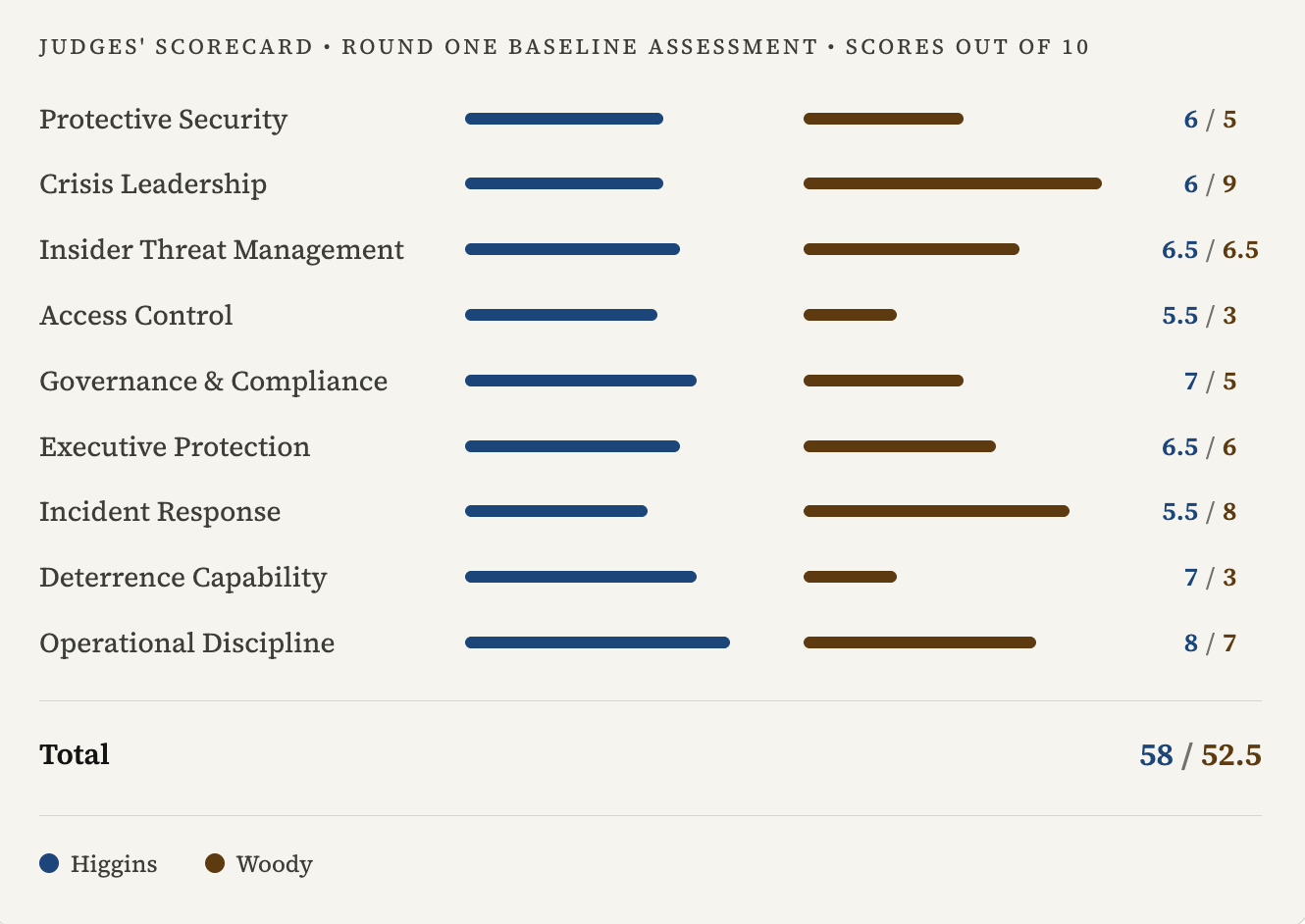
Higgins has the training, the protocols, the military bearing, and the Dobermans. Magnum has the guest cottage. Woody has none of the conventional tools of security leadership, an operational record that most conventionally equipped professionals would find difficult to explain, and a score of nine in crisis leadership that no other candidate in Round One has come close to matching.
The Broader Verdict
The panel wishes to acknowledge, before announcing the result, that this is the match in which the competition has produced its most genuinely ambivalent finding. Both candidates are principled. Both are committed. Neither would disgrace the CSO role, and each brings qualities that the other lacks in ways that a genuine composite would find invaluable.
The governance formulation that best captures their respective limitations is a simple one. Strong governance without trust creates compliance without commitment: people follow the procedures because they must, not because they believe in them, and the moment supervision is absent or the procedure fails to cover the situation, the compliance disappears with it. Strong culture without accountability creates goodwill without resilience: people believe in the mission and follow the leader, but without structural scaffolding, the entire edifice is one leadership failure away from collapse. Higgins has governance that leans towards the first failure mode. Woody has culture that leans towards the second. The most effective security leadership integrates both. Only one of them can advance.
Higgins advances on the strength of his institutional framework, his governance practice, his deterrence capability, and his operational discipline. These are the qualities that an organisation at baseline most needs from its security leadership: a structured, documented, consistently applied programme that creates reliable security practice as a matter of course. Higgins would build an organisation that functions. It would have at least one persistent access control problem he cannot resolve without principal-level guidance he may never receive, and it would carry a risk of control creep that an absent principal cannot check. But it would function.
Woody's loss is genuinely narrow. His crisis leadership score of nine is the highest the competition has awarded any candidate in Round One for any single discipline, and it is warranted. His insider threat management is sophisticated, his incident response is exceptional, and his operational discipline derives from a depth of values that formal training rarely generates. The panel notes that several of the quarter-final scenarios currently being designed will favour exactly the qualities Woody possesses: adaptability under novel threat conditions, leadership without positional authority, and crisis resolution through collaborative action under extreme pressure. Had this match occurred in the quarter-finals rather than Round One, the panel is not confident the result would have been the same.
Higgins advances. The panel commends him and observes that he should, upon receiving this result, permit Magnum a celebratory beverage from the main house. He will do no such thing, of course. Some security cultures are impervious to goodwill. This is, in its way, also a finding.
PANEL DECISION • ROUND ONE, MATCH FOUR
Jonathan Higgins advances
By 58 points to 52.5, the narrowest result of Round One. Higgins' institutional framework, governance practice, and operational discipline provided a sufficient margin over Woody's exceptional crisis leadership and incident response. The panel records that 52.5 is the highest score achieved by a losing candidate in this competition so far, that Woody's crisis leadership rating of nine is the highest single-discipline score in Round One, and that Sheriff Woody Pride would be a serious candidate in any scenario-based round that rewards adaptability, moral leadership, and crisis resolution under conditions of institutional pressure. The competition has not seen the last of him as an analytical reference point, even if it has seen the last of him as a contestant.
Next match in the World's Greatest CSO Competition: to be announced. The panel observes that Round One has now produced four advancing candidates with notably different profiles: a procedural administrator with governance strength and tactical weakness; a principled strategist with exceptional governance and measured operational capability; a relentless enforcer with extraordinary tactical ability and a serious legitimacy deficit; and a trained military professional whose designed security programme underperforms its specification. The quarter-final scenarios will be interesting. The panel is already looking forward to them.