

Match 3 - Judge Joseph Dredd VS Chief Clancy Wiggum
🏆 WORLD’S GREATEST CSO COMPETITION 🏆
ABOUT THE COMPETITION FORMAT
Round One focuses on foundational leadership capability: leadership philosophy, governance maturity, operational style, and organisational culture. These baseline assessments establish each contestant's profile before the competition moves into specific operational scenarios in the quarter-finals, where context will shift the rankings in ways that broad capability analysis cannot predict. A strong showing here is no guarantee of progression. A poor showing is not necessarily fatal, though in Chief Wiggum's case the panel is not optimistic.
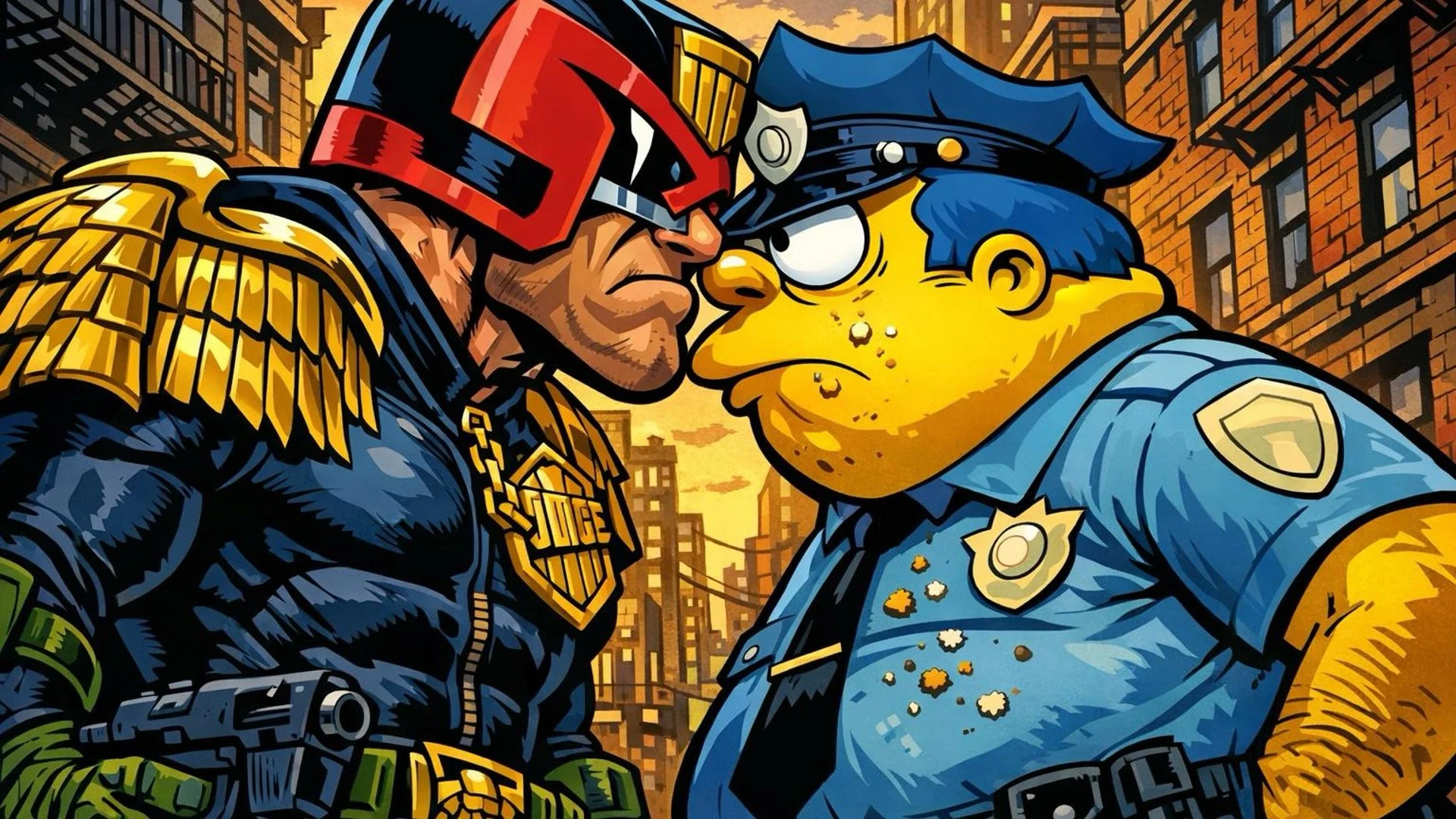
Both men are, technically, officers of the law. One is incorruptible, operationally devastating, and personally responsible for the judicial processing of approximately a quarter of Mega-City One's criminal population. The other is what institutional entropy looks like when it achieves middle management, an officer whose relationship with operational seriousness has been, at best, occasional. The panel acknowledges from the outset that this is not a close contest. The more interesting question is precisely why it is not, and what the distance between these two candidates reveals about security leadership at its extremes.
The Enforcement-Legitimacy Spectrum
The most useful analytical frame for this matchup is not competence versus incompetence, though that dimension is certainly present. It is the relationship between enforcement capability and institutional legitimacy, and what happens to security programmes at the extremes of that spectrum.
An effective security function requires both. Enforcement capability without legitimacy becomes coercion: it achieves compliance by replacing trust with fear, and it produces an organisation that cannot distinguish between the security function and the threat. Legitimacy without enforcement capability is theatre: it maintains appearances but provides no actual protection, and eventually teaches the communities it is meant to serve that security is a performance rather than a reality.
Judge Dredd sits at the maximum-enforcement end of this spectrum with a completeness that is almost philosophically pure. His greatest operational weakness is not capability but what might fairly be called institutional imagination: he sees security as a compliance problem, and a compliance problem only. Rules exist. Rules are broken. Violators are punished. This is highly efficient tactically and creates serious strategic vulnerabilities that become apparent over time. Chief Wiggum, by contrast, represents institutional entropy in its most fully developed form: processes that exist but are not respected, authority that exists but is not credible, and standards that are applied with a selectivity that, over a long career, has come to resemble deliberate policy.
The distance between them is the distance between two different ways of failing the communities that security is meant to protect. This article is, in part, an exploration of that distance.
Setting the Scene
Judge Joseph Dredd patrols the sectors of Mega-City One, a future megalopolis of eight hundred million people, as judge, jury, and, when he considers it warranted, executioner. His authority is absolute within his jurisdiction, his physical capability is extraordinary, his dedication to the letter of the law is without exception, and his tolerance for criminal conduct of any kind is, in the most clinical sense, zero. He has been on active duty for decades without corruption, without compromise, and without, so far as the panel can determine, a single documented instance of personal doubt. He is a remarkable security professional and a deeply alarming governance model.
Chief Clancy Wiggum commands the Springfield Police Department, a force of indeterminate size operating under democratic municipal oversight in a mid-sized American city whose crime statistics suggest that the oversight has not been especially rigorous. Wiggum has brought to his role the full apparatus of institutional decay: a department that has grown culturally unserious about risk, in which incidents are mishandled, investigations are inconsistent, and personnel accountability is applied with a randomness that, on close examination, appears structural rather than accidental. He is, additionally, the only law enforcement leader in this competition with a plausible claim to having lost operational control during a bake sale.
Protective Security
Dredd's protective security posture is built on personal omnipresence and the absolute certainty that any threat to persons within his patrol sector will be met with immediate and overwhelming force. No reasonable adversary tests a perimeter that Dredd is actively defending. His protective effectiveness is not merely a function of capability but of reputation, which is one of the more durable protective security assets a practitioner can possess. Citizens in his sector are protected, and they know it. The knowledge that Dredd is present is itself a security control.
It is worth pausing here on a tension in Dredd's protective model that becomes more visible in institutional contexts. Security exists to enable operations, not to suffocate them. The most effective protective security postures are those that create genuine safety while remaining permeable enough for the people and activities the organisation depends on. A fortified environment in which personnel feel surveilled rather than protected, and in which the security apparatus communicates distrust rather than assurance, generates its own costs: reduced information sharing, suppressed anomaly reporting, and a workforce that complies with security measures without understanding or endorsing them. Dredd's model, transplanted into a modern corporate or public institution, risks exactly this outcome.
Wiggum's protective security record invites a different kind of analysis. Springfield's citizens are, by any statistical measure, in a state of near-continuous jeopardy that the police department does not materially reduce. His protective posture is reactive to a degree that stretches the definition of the word, typically manifesting as a police report and a brief expression of sympathy administered after the relevant event has concluded. The panel notes that genuine protective acts have occasionally occurred under Wiggum's watch, but they appear to be the product of accident rather than design, and are generally as surprising to him as to anyone else.
Advantage: Dredd, comprehensively.
Crisis Leadership
Dredd's crisis leadership is decisive in a way that most security practitioners can only aspire to, and limiting in a way that is worth examining carefully. His crisis response set is essentially singular: maximum lawful force, applied immediately, without hesitation or negotiation. This approach resolves a remarkable proportion of the crises he encounters, because many crises are resolvable through the decisive application of overwhelming force. The problems arise in the subset of crises that require something else: de-escalation, negotiation, management of competing legitimate interests, or measured proportionality that produces outcomes rather than just conclusions.
Modern crises increasingly involve media scrutiny, political sensitivity, stakeholder management, legal oversight, and reputational consequence. Pure coercive authority performs poorly in these environments. A CSO who escalates every issue through force eventually generates secondary risks: public distrust, regulatory backlash, workforce disengagement, and executive exposure. Dredd would likely stabilise an immediate incident with formidable competence while simultaneously generating a commission of inquiry. He does not consider the latter problem because, within his operational framework, commissions of inquiry are not something that happens to judges. They are a feature of lesser governance models.
Wiggum's crisis leadership follows a characteristic pattern: delayed engagement, incorrect threat assessment, misdirected resource deployment, and eventual resolution by processes other than deliberate policing. When the situation demands communication, his press conferences tend to involve misplaced evidence, incoherent timelines, and a relationship with the available facts that is best described as aspirational. He has resolved crises on occasion, but the mechanism appears to be persistence of a very specific kind: remaining at the scene long enough that the situation organises itself around him, at which point he presents himself as a participant in the outcome.
Advantage: Dredd. His crisis leadership is limited in range. Wiggum's is absent in practice.
Insider Threat Management
This category produces the most analytically important finding of the matchup, and it is not a finding that reflects well on either candidate.
Wiggum does not manage insider threat. He is insider threat. His selective enforcement, his documented willingness to accommodate local criminal interests in exchange for various considerations, and his practice of applying different standards of scrutiny depending on his relationship with the subject represent an active corruption of the security function. It is important to distinguish this from mere incompetence. Incompetence fails to prevent harm. Corruption enables it deliberately. The Springfield Police Department's insider threat problem is not that Wiggum might be manipulated by a sophisticated adversary. It is that he has already made his accommodations, knows he has made them, and has no serious intention of reversing them.
Corruption as a systemic security failure: Organisational corruption is categorically different from operational incompetence, and the distinction matters enormously in security governance. An incompetent security function fails to deliver protection. A corrupt one actively compromises it, creates false assurance, and suppresses the reporting mechanisms that might otherwise identify the failure. The most dangerous characteristic of a corrupt security culture is not what it does. It is what it prevents others from seeing.
Dredd's personal incorruptibility is significant and genuine. However, his surveillance-heavy enforcement model, while theoretically superior for detection, carries a specific insider threat vulnerability: fear-based systems drive malicious behaviour underground rather than eliminating it. Personnel who conceal mistakes, suppress concerns, and disengage psychologically from organisational mission create fertile conditions for sophisticated insider threat actors, precisely because the culture that should surface anomalies has been trained to suppress them instead. Effective insider threat management depends heavily on voluntary cooperation: the willingness to report anomalies, share concerns, escalate mistakes early, and exercise judgement beyond procedure. These are behaviours that confident, psychologically safe workforces exhibit naturally. They are behaviours that coercive environments systematically destroy.
Both men would miss a sophisticated insider threat, but for entirely different reasons. Wiggum because he has been compromised. Dredd because the culture he creates teaches people to hide things from him.
Advantage: Dredd, though the panel notes his insider threat capability is more impressive when directed outward than when directed at the conditions his own leadership creates.
Access Control
Dredd's access control is absolute within his active jurisdiction. He does not admit the unauthorised. He does not accept inadequate credentials. He does not make exceptions based on social pressure, seniority, or the convincingness of someone's excuse. His challenge-and-response discipline is maintained without variation regardless of circumstance, which is precisely the standard that access control theory requires and which virtually no real organisation consistently achieves.
Springfield's access control posture is, generously characterised, permissive. Wiggum's processing of access-related incidents suggests a mental model in which most places are accessible to most people most of the time, and departures from this default require a level of motivation on his part that is rarely summoned before lunch. The panel notes that Springfield's nuclear facility, while nominally a separate institutional concern, represents a data point about the broader access control culture of the municipality that is difficult to set entirely aside.
Advantage: Dredd, entirely.
Governance and Compliance
This is the category in which the competition's most important analytical finding emerges, and it complicates the simple narrative of Dredd as the obvious superior candidate.
Wiggum's governance framework is, on paper, more legitimate than Dredd's. He is a public servant operating under democratic municipal oversight, nominally accountable to elected officials and, through them, to the citizens of Springfield. The governance architecture exists: there is a mayor, a city council, budget processes, and accountability mechanisms. That these mechanisms have failed to produce any meaningful improvement in Springfield's security outcomes over a very long period reflects a catastrophic failure of governance practice rather than governance principle. A corrupt officer operating within a legitimate framework is a remediable problem. The framework provides the scaffolding for correction, even when the correction is long overdue.
Dredd's governance posture is considerably more troubling when examined without the distraction of his operational effectiveness. He operates within the Justice Department, which provides internal hierarchy and a degree of intra-institutional accountability. But there is no democratic mandate, no separation of powers, no civil liberties framework constraining his authority, no external audit mechanism, and no meaningful appeal from his decisions. He is, as he frequently reminds those he is processing, the law. An institution that cannot be questioned, challenged through legitimate channels, or corrected by external mechanisms is not a governance framework. It is an ideology with a badge.
The legitimacy deficit in security governance: Enforcement capability without democratic accountability creates a specific and underappreciated security risk: the security function itself becomes a source of harm that the communities it is meant to protect have no formal mechanism to address. The question of who watches the watchmen is not rhetorical in security governance. It is the foundational question of whether a security programme is a public good or a power structure. An incorruptible officer in an illegitimate framework and a corrupt officer in a legitimate one are both serious failures. They are simply different serious failures.
Advantage: Dredd, narrowly, on the strength of his consistent internal standards. The panel awards this with less confidence than any other category in the match.
Executive Protection
Dredd as a close protection resource is formidable. His threat assessment is rapid and accurate, his physical interposition between principal and threat is reflexive, and his willingness to absorb personal risk is without limit. He would not lose a principal through negligence, distraction, or underestimation of the threat environment. He might, in certain scenarios, convert a manageable threat into a terminal one through disproportionate escalation, but this is a proportionality failure rather than a protection failure in the strict sense.
Wiggum's executive protection record does not exist in any meaningful form, because executive protection requires advance planning, threat assessment, route selection, and sustained situational awareness across an extended period. The panel does not doubt that Wiggum would attempt to protect an assigned principal. It doubts that the attempt would be structured in a way that materially improved the principal's prospects.
Advantage: Dredd.
Incident Response
Dredd's incident response is, within the competition field, among the most operationally effective. His response time is essentially zero: he does not wait for backup, does not assess whether the situation warrants personal involvement, and does not consult a framework before acting. The certainty and speed of his response are genuine security assets. They reflect a quality that many well-governed, well-resourced organisations struggle to produce: the willingness to commit without complete information when commitment is what the moment requires.
The proportionality of his response is a separate question, and not a small one. His use-of-force calibration is set to a threshold that would not survive review under any modern use-of-force policy framework. This produces rapid incident resolution and, periodically, incidents of a different kind.
Wiggum's incident response follows a characteristic pattern: late arrival, incorrect initial assessment, engagement with the wrong element of the situation, and eventual resolution by processes other than deliberate policing. Springfield's incidents do generally resolve. The mechanism is usually the passage of time, and Wiggum has developed a philosophical equanimity about this that is, the panel acknowledges, almost admirable.
Advantage: Dredd. The gap between these two candidates on incident response is the largest in the competition so far.
Deterrence Capability
Dredd's deterrence model rests on what criminological research consistently identifies as the most effective deterrence mechanism available: not the severity of consequence, but its certainty. Criminals in Mega-City One do not primarily fear what Dredd will do to them. They fear that he will absolutely, without exception, under any circumstances, do it. The predictability of consequence is more deterrent than its extremity, and Dredd's contribution to deterrence theory is essentially a proof of that proposition at the most extreme possible scale.
Wiggum's deterrence capability is, the panel is compelled to report, effectively negative. Not merely absent, but actively counterproductive. A criminal community that has observed Wiggum's enforcement patterns over sufficient time understands not merely that the probability of apprehension is low, but that his presence at a crime scene can occasionally be an asset rather than a liability. This is deterrence in reverse, and it is a failure mode that receives insufficient attention in security governance literature: a security presence that reassures adversaries rather than deterring them.
Advantage: Dredd.
Operational Discipline
Dredd's operational discipline is, at the personal level, without peer in this competition. He is consistent to a degree that approaches the mechanical: the same standards, the same procedures, the same threshold of tolerance for deviation, applied without variation regardless of who is asking, who is watching, or what the personal cost of consistency might be. Security cultures take their character from the person at the top of the function, and Dredd's behaviour communicates, with absolute clarity, that standards are not aspirational guidelines. They are the floor.
The limitation of Dredd's operational discipline is its personal nature. It is his discipline. His sector operates to his standard because he is present to enforce it. He has not built an institution that sustains his standards without him. He has sustained his standards himself, which is a different and considerably more fragile thing. Institutions built on the discipline of one exceptional individual tend to collapse to the mean when that individual is absent. The question of what Mega-City One's criminal justice looks like when Dredd is not present is answered, in the canonical record, with some alarm.
Wiggum's operational environment raises a counterintuitive point that the panel is reluctant to raise, because it risks being misread as an endorsement of incompetence, which it is not. Organisations with very low procedural rigidity occasionally exhibit a form of adaptive resilience that highly disciplined, process-heavy environments struggle to replicate. In Wiggum's department, people improvise constantly, information flows informally through whatever channels are available, rigid hierarchy is weak to the point of irrelevance, and decision-making is effectively decentralised by accident rather than design. These are not virtues. But they are conditions that sometimes produce flexible responses to novel situations, precisely because there is no established procedure requiring everyone to wait for authorisation before acting.
The resilience paradox in low-control environments: Organisational security research has identified a counterintuitive finding: some dysfunctional, low-control environments survive crises that destroy well-ordered ones, because they have never developed the institutional rigidity that breaks under sudden pressure. Flexibility, informal information flow, and decentralised judgement, when they exist by accident rather than design, can produce adaptive responses that procedural cultures struggle to replicate. This is not an argument for chaos. Overly rigid systems can become brittle; overly chaotic ones become unreliable. The lesson for security leadership is that resilience requires both structure and the capacity to deviate from it when conditions demand.
To be entirely clear: Springfield does not survive because of Wiggum. It survives, to the extent that it does, largely despite him. No reasonable governance framework would model its operational culture on the Springfield Police Department, and the panel has no intention of suggesting otherwise. But the phenomenon is worth naming, because its mirror image, the organisation so disciplined that it cannot function when the plan stops matching reality, is a failure mode that real security leaders encounter with uncomfortable regularity.
Advantage: Dredd, decisively. Fear produces compliance. Respect produces capability. Neither produces the other. But discipline that cannot survive the absence of its enforcer is not yet an institution.
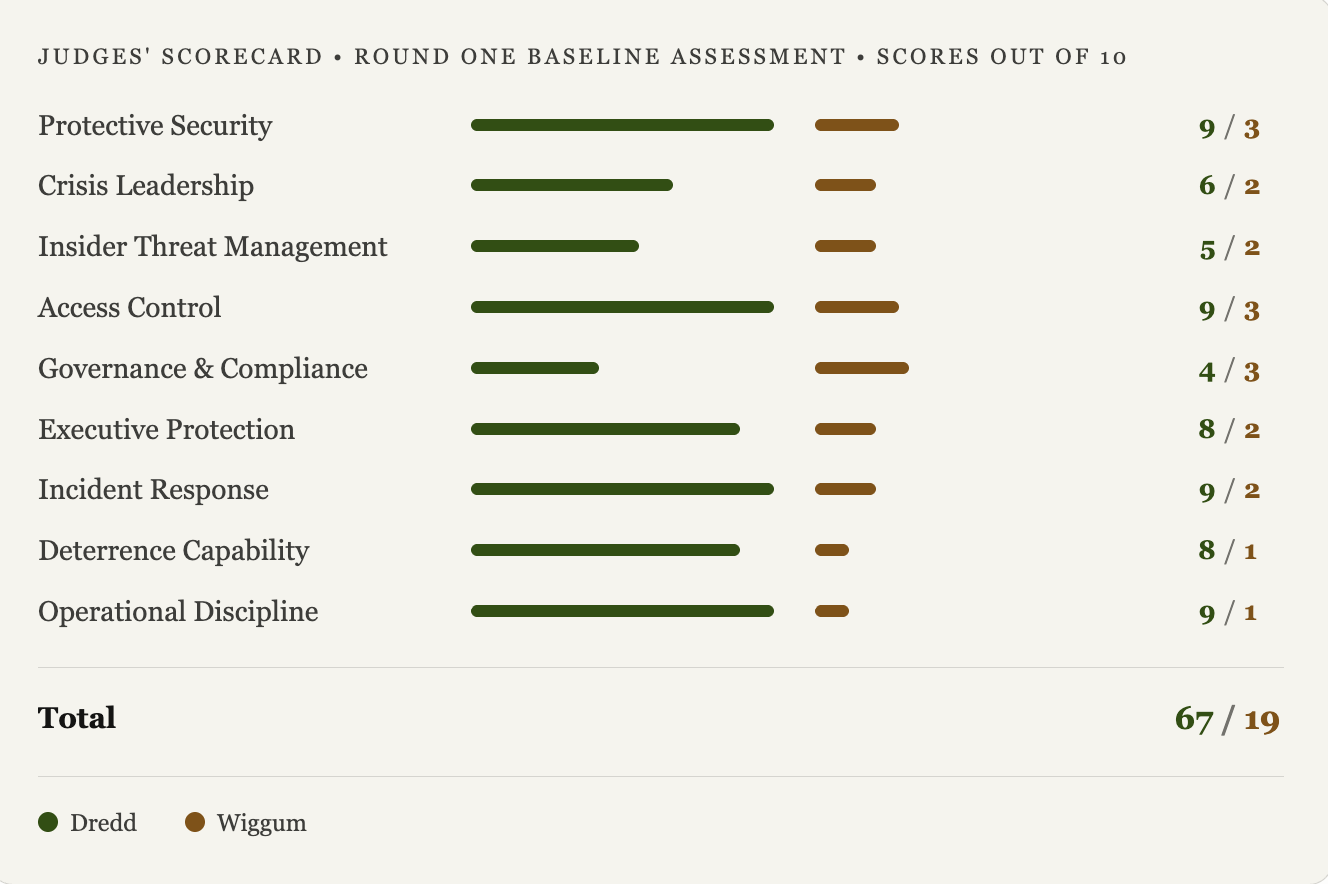
Dredd is the law, which is simultaneously his most impressive quality and his most serious governance deficiency. Wiggum is technically also the law, which is Springfield's most serious governance deficiency. The distance between these two positions is not a spectrum. It is a warning.
The Broader Verdict
The panel wishes to be clear that this result, whilst lopsided, is not without analytical interest. The combined picture these two candidates paint is one of the more instructive in the competition, precisely because they represent not merely incompetence at different levels but two distinct and well-documented failure modes of the security function.
Dredd fails upwards. His individual capability is extraordinary, his personal standards are impeccable, and his operational effectiveness is beyond reasonable dispute. But the system he represents has removed every check, balance, and corrective mechanism that might constrain that capability when it is wrong. A security function that cannot be challenged is not a security function. It is an authority structure. Authority structures without external accountability eventually serve themselves rather than the communities they are meant to protect, and security built entirely on enforcement and fear can maintain order while remaining unable to sustain the one thing that makes security durable: the voluntary cooperation of the people it is meant to protect. Dredd's model, however effective in short-term stabilisation, carries long-term cultural and ethical risks that real organisations cannot ignore. Institutions built entirely on coercive authority eventually collapse beneath the weight of their own rigidity.
Wiggum fails downwards. He has not merely failed to build a security function. He has, through corruption, selective enforcement, and the comfortable inertia of an officer who has decided that personal ease and professional duty are compatible objectives, actively undermined the legitimate governance framework within which he operates. This is the more corrosive failure mode, because it is harder to see, harder to prove, and tends to persist precisely because the people who might address it have been, in various ways, accommodated by it.
Dredd advances. He does so with a score that reflects genuine operational excellence in most categories, tempered by a governance profile that the competition's later rounds will examine with some rigour. The quarter-final scenarios will introduce contexts in which Dredd's binary enforcement model is tested against situations requiring something other than the law applied without interpretation. Those situations exist in every real security environment. Whether Dredd can navigate them without becoming the problem he was appointed to solve is a question that remains, at this stage, productively open.
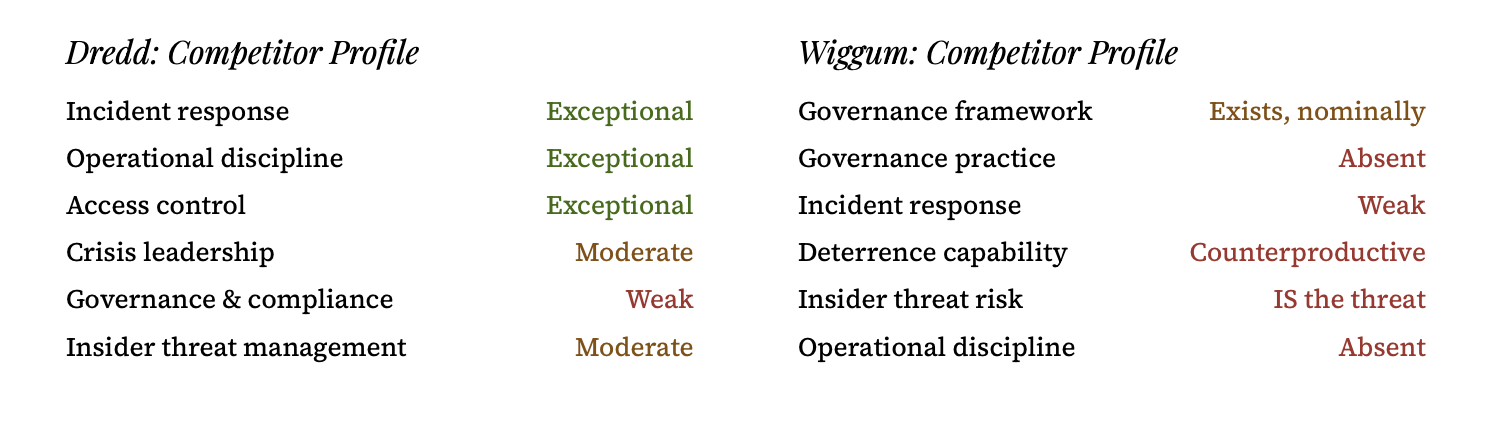
PANEL DECISION • ROUND ONE, MATCH THREE
Judge Dredd advances
By 67 points to 19, on aggregate score across nine foundational disciplines. This is the most one-sided result of Round One and is, in the panel's assessment, an accurate reflection of the operational distance between these two candidates. Dredd's governance deficit is real and will be examined in later rounds. Wiggum's is, in the panel's view, disqualifying at any stage of a competition purporting to identify credible security leadership. Chief Wiggum is thanked for his participation and advised that his vehicle has been ticketed in the car park, though he is welcome to contest this if he can locate the relevant officer.
Next match in the World's Greatest CSO Competition: to be announced. The panel notes that three matches into Round One, a pattern is emerging: strong tactical operators with weak governance profiles are advancing alongside candidates whose governance credentials are stronger but whose operational capability under pressure remains untested. The quarter-final scenarios are being designed with this profile distribution specifically in mind. The competition, despite this match's one-sided scoreline, remains genuinely uncertain at the level of the overall bracket.