

Match 2 - Captain Jean-Luc Picard VS Lord Darth Vader
🏆 WORLD’S GREATEST CSO COMPETITION 🏆
ABOUT THE COMPETITION FORMAT
Round One focuses on foundational leadership capability: leadership philosophy, governance maturity, operational style, and organisational culture. These baseline assessments establish each contestant's profile before the competition moves into specific operational scenarios in the quarter-finals, where context will shift the rankings in ways that broad capability analysis cannot predict. A strong showing here is no guarantee of progression. A poor showing is not necessarily fatal.
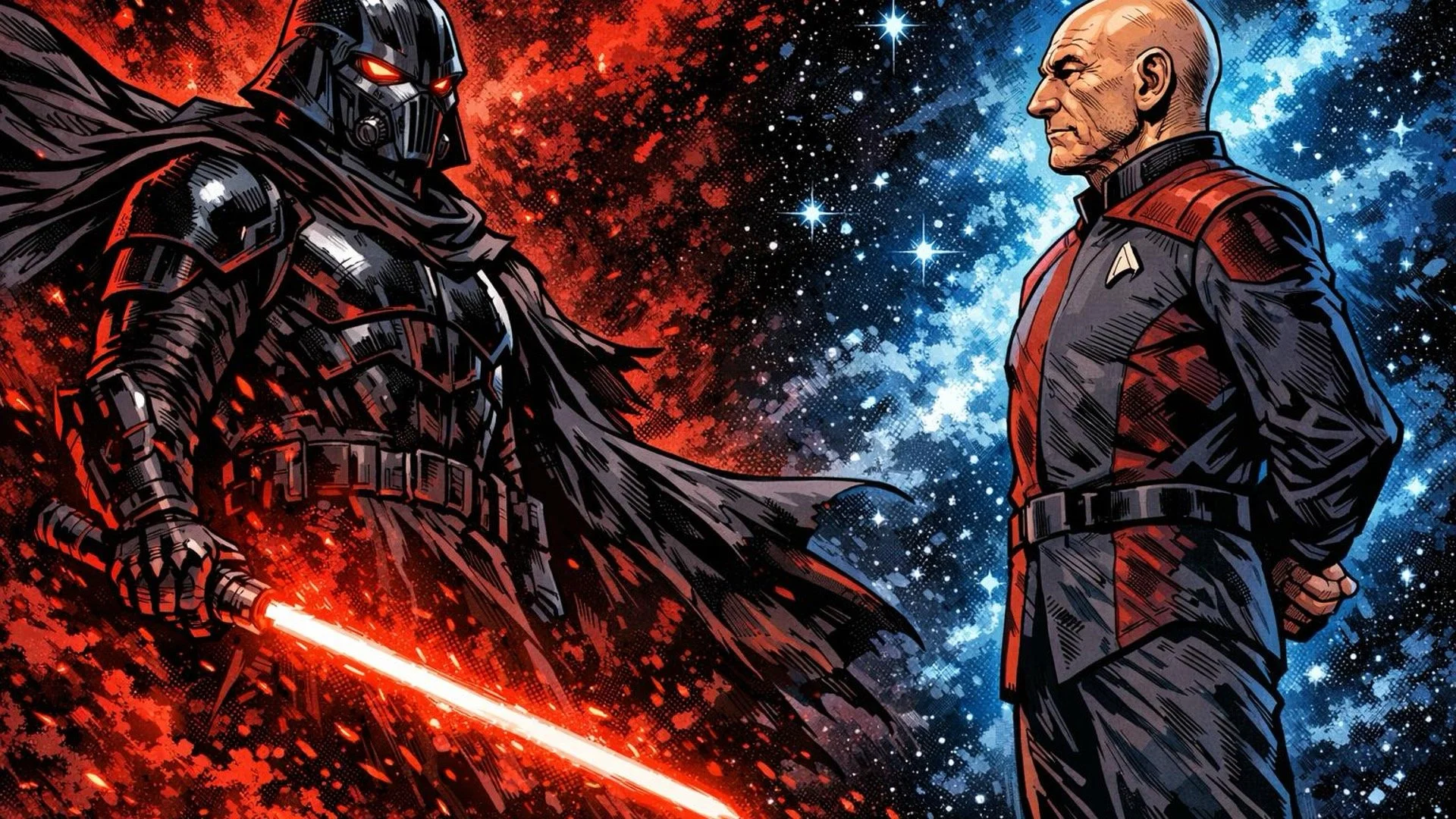
One is among the most respected leaders in the known galaxy: principled, erudite, and capable of resolving a hostage situation with a Shakespeare quotation and a pot of Earl Grey. The other is what happens when exceptional talent, unresolved trauma, and unlimited executive authority combine without meaningful HR oversight. In the second match of our competition to crown the world's greatest Chief Security Officer, the panel examines whether wisdom and governance can outperform raw terror as a security leadership model. The answer, it transpires, is complicated.
The Question That Makes This Matchup Interesting
On paper, this should be straightforward. One candidate is a decorated Starfleet captain with an exemplary record in diplomacy, crisis management, and institutional leadership. The other runs his security operation through a combination of supernatural coercion, summary execution of underperforming officers, and a results-oriented management philosophy in which the result desired is, specifically, terror.
And yet the panel declines to treat this as settled. Because Darth Vader represents something real. In security leadership circles, the temptation towards coercive authority is never far from the surface. The logic is seductive: visible power produces compliance, compliance produces order, and order produces security. This is not an entirely invented argument. It simply happens to be wrong in ways that matter enormously over time, and in ways that the competition's later scenario rounds are likely to expose with some violence.
The more interesting question this matchup poses is not whether principled leadership beats authoritarian coercion. It is precisely why coercive security cultures fail, and what the failure looks like from the inside before it becomes catastrophic. Vader provides an unusually well-documented case study.
Setting the Scene
Jean-Luc Picard commands the USS Enterprise, flagship of Starfleet, with a crew of over a thousand personnel operating across environments of extraordinary complexity and threat diversity. He has navigated first contact scenarios, civil wars, temporal anomalies, and adversaries that defy conventional threat assessment. His operating model is built on earned authority, institutional legitimacy, and a genuine belief that the best security outcomes are achieved through cohesive, empowered teams operating within a clear ethical framework. He is, additionally, the only senior leader in this competition with a demonstrable record of convincing omnipotent beings to reconsider their life choices through the application of reasoned argument.
Darth Vader serves as the primary enforcement arm of a Galactic Empire: a one-man strategic weapon wrapped in black armour and unresolved resentment. His operational portfolio includes sector security, fleet command, internal compliance, and the personal protection of Emperor Palpatine. His methods are immediate, his deterrence is extraordinary, and his tolerance for operational failure is, to put it gently, minimal. His respiratory acoustics alone would trigger multiple workplace wellbeing reviews across the Federation. His subordinates perform, partly out of professional commitment and partly because the alternative is asphyxiation without physical contact, which concentrates the mind considerably.
Let us assess them across the nine disciplines.
Protective Security
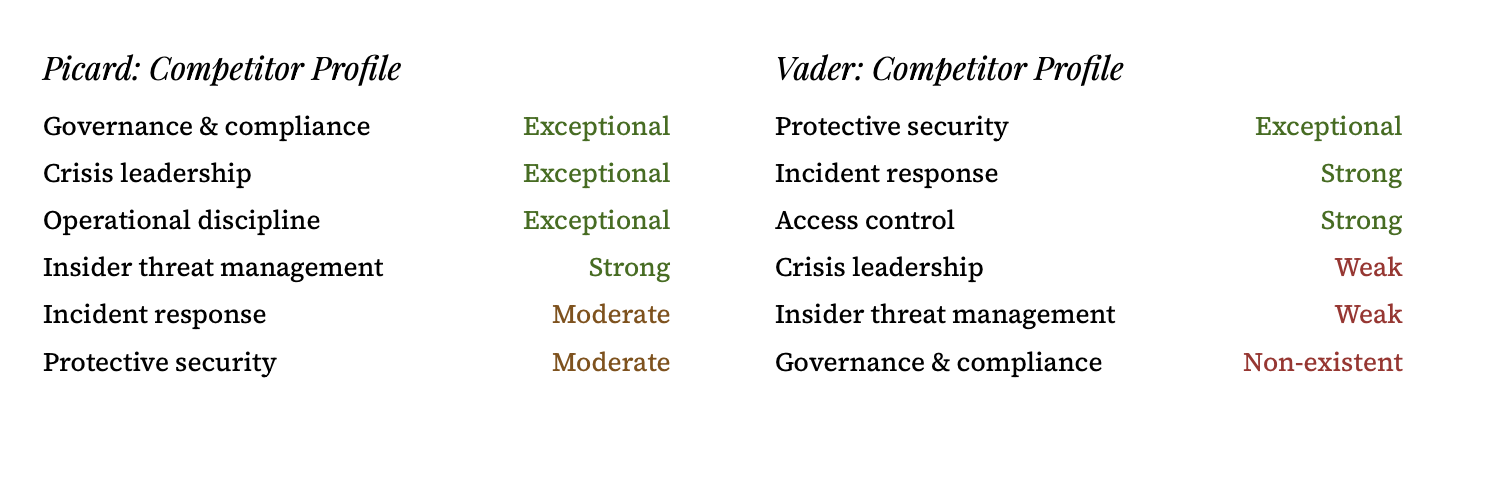
Vader's protective security posture is, in physical terms, formidable to a degree that no conventional analysis can fully capture. His personal presence transforms the threat calculus of any environment he occupies. Adversaries who might test a defended perimeter against standard security personnel will not test one anchored by a figure who can perceive deception through means unavailable to any existing technology and respond at a speed and lethality that renders conventional threat assessment largely irrelevant. The deterrent value of Vader as a protective security asset is, within his operational context, essentially unquantifiable.
Picard's protective security record is less dramatic but considerably more transferable. He positions experienced personnel correctly, deploys available technology intelligently, and maintains a defensive posture that is proportionate to the actual threat environment rather than the most feared hypothetical one. His approach is grounded in risk assessment rather than projection of dominance, which produces a calmer operating environment and, crucially, a workforce that engages with security measures as sensible precautions rather than instruments of an authority to be feared.
Advantage: Vader, in narrow technical terms. His personal capability is without peer. The panel notes, however, that a protective security programme built around one individual's supernatural abilities is not a sustainable institutional model. When the individual is unavailable, compromised, or, as history will record, experiencing a moment of filial sentiment, the programme has no depth.
Crisis Leadership
This is Picard's strongest category and the one in which the gap between the two candidates is most revealing about the nature of genuine security leadership.
Picard under pressure is one of the more instructive models of crisis leadership available to the practitioner, even allowing for the considerable unreality of his operating environment. He gathers information before committing. He consults specialists without surrendering decision authority. He communicates clearly under conditions of significant ambiguity, maintains the confidence of his team without false reassurance, and retains the flexibility to revise his approach as the situation evolves. He has resolved temporal paradoxes, negotiated with hostile Romulans, and stabilised his crew when the ship itself has been used as a weapon against them. Critically, he creates an environment in which his officers feel able to offer contrary views and raise concerns without fear of consequence. This is not sentimentality. It is the operational foundation of effective crisis decision-making, because leaders who punish dissent receive no early warning of deteriorating situations until deterioration has become collapse.
There is a further dimension to Picard's crisis capability that this article would be remiss to overlook. He reads people with extraordinary precision, understands motivation, and has demonstrated an ability to psychologically destabilise adversaries far more powerful than himself through the application of reasoned, targeted argument. His interrogation resistance under Cardassian torture is the stuff of Starfleet legend. His record of unsettling opponents mid-confrontation by identifying and naming the contradiction between what they claim to believe and how they are actually behaving is, in the panel's assessment, a genuine security capability. One can easily imagine Picard facing Vader and saying, with the measured calm of a man who has done this before: "You have confused obedience with purpose." The probability of Vader then staring silently into the middle distance while Imperial officers pretend not to notice is, the panel judges, non-trivial.
Vader's approach to crisis management is rather more direct. He enters the situation, identifies the responsible officer, and resolves the staffing problem. This method does create a form of accountability. It does not, however, foster the kind of institutional learning that prevents the next crisis from occurring, and it produces an officer corps conditioned to hide problems rather than surface them early.
Advantage: Picard, and it is not particularly close. Crisis leadership is where the difference between authority and wisdom becomes operationally consequential.
Insider Threat Management
The panel approaches this category with some care, because it contains what may be the most analytically significant finding of this entire matchup.
Vader's leadership model is, almost without exception, the single most effective generator of insider threat conditions that the competition panel has encountered. His practice of executing officers who deliver bad news is not merely a governance failure. It is a systemic destruction of the organisation's early warning capability. When subordinates learn that admitting problems leads to their termination in the most literal sense, they stop admitting problems. Operational failures are concealed, risks are underreported, and the leadership receives an increasingly distorted picture of organisational reality. The Death Star's destruction was not solely an engineering failure. It was, in part, an intelligence failure of the kind that coercive cultures reliably produce: too many people knew about the exhaust port vulnerability and too few were willing to be the one who raised it.
Fear-based security cultures and insider threat: The relationship between coercive leadership and insider threat is well established in organisational security research. When personnel perceive that raising concerns carries personal risk, near-miss reporting collapses, behavioural anomalies go unescalated, and the conditions for both insider compromise and catastrophic operational failure develop silently. The most dangerous insider threat is rarely the employee with grievances. It is the culture that taught everyone else not to speak.
There is a further irony so exquisite that the panel is compelled to note it. Vader himself is, by any reasonable definition, the most consequential insider threat in galactic recorded history. His eventual betrayal of Emperor Palpatine represents an insider event of such magnitude that no risk register could contain it. The most feared enforcer of the Imperial security apparatus was, at the moment of maximum operational consequence, a threat to the very principal he was protecting. This is not a small observation. It is also, the panel notes, a predictable outcome of a leadership culture built on coercion rather than commitment. The moment the coercive relationship was disrupted by a sufficiently powerful emotional trigger, the loyalty it had purchased evaporated entirely.
Picard, by contrast, builds organisations in which concerns are surfaced, anomalies are discussed, and trust is earned rather than demanded. His crew reports problems. His officers disagree with him openly. His security posture benefits from information that reaches the top of the command structure without being filtered by fear. This is what effective insider threat management actually looks like in practice.
Advantage: Picard, and by a margin that the scorecard will struggle to fully express.
Access Control
In raw enforcement terms, Vader's access control record is exceptional. Unauthorised personnel do not penetrate his perimeters through force of will, social engineering, or any mechanism available to a conventional adversary. His physical presence at a control point is itself an access control system. The authentication challenge he presents is, for most potential intruders, existential rather than procedural.
Picard's access control is structured, credentialed, and appropriately layered. Starfleet protocols are followed, access rights are managed through legitimate channels, and exceptions are handled through proper authorisation pathways. It is a system designed to function consistently across an entire organisation rather than relying on one individual's capacity for deterrence. It will not stop Vader. It will stop most other things.
The panel notes that Vader's access control supremacy contains its own vulnerability: the Rebels eventually walked in through the front door of Endor's Imperial facility through a combination of social engineering, false credentials, and the distraction of Vader's attention being elsewhere. A system predicated on one individual's omnipresence is, by definition, one absence away from failure.
Advantage: Vader, on operational effectiveness in normal conditions. Picard on systemic resilience.
Governance and Compliance
Picard's governance record is, within the competition field, likely to remain unsurpassed. He operates within a comprehensive institutional framework, submits to external accountability mechanisms that he does not always agree with, and maintains a commitment to procedural legitimacy even when departing from established procedure would produce better immediate outcomes. His Starfleet conduct reports are, one imagines, extremely thorough and impeccably accurate, including the occasions on which the report reflects poorly on his own decisions. This is not a trivial quality. Security leaders who build governance frameworks only for the easy situations are not building governance frameworks. The test of institutional commitment is whether it holds when circumventing it would be convenient, legally defensible, and operationally advantageous.
Vader operates outside any governance framework that could reasonably be called legitimate. He reports to an Emperor whose own authority rests on the violent dissolution of the democratic institutions he replaced. His compliance obligations are defined entirely by the preferences of a volatile superior whose instructions are neither consistent nor constrained by law. He has no board, no audit function, no external accountability, no whistleblowing channel, and no mechanism by which operational failures are reviewed by anyone other than the person most invested in concealing them.
The panel also wishes to place on record that the Empire's approach to safety-in-design governance is, to put it charitably, inadequate. An organisation that constructs a moon-sized weapons platform with an unguarded thermal exhaust port leading directly to the main reactor, and which does not install handrails near any shaft connected to a significant drop, has not merely failed its health and safety obligations. It has produced a compliance record that would be difficult to defend before any regulatory body that had survived the initial audit process. This is governance failure made structural.
Advantage: Picard, comprehensively. The panel has rarely awarded a score in this category with greater confidence or less ambiguity.
Executive Protection
This is a genuinely contested category, and the panel has deliberated at some length.
Vader's executive protection record, measured solely by the metric of principal survival up to the point of the Battle of Endor, is largely strong. Emperor Palpatine survived for decades under Vader's protection through environments of extraordinary threat. The protection arrangements were comprehensive, the intelligence capability was substantial, and the deterrent effect of Vader's proximity made direct physical assault on the Emperor a proposition that very few adversaries considered viable.
Picard's executive protection approach is considered, planned, and appropriately proportionate. He does not overprotect in ways that create operational paralysis, nor underprotect through an excess of confidence. His track record of securing the safe movement of dignitaries, officials, and heads of state through contested environments is solid, if unspectacular.
The panel awards this category to Vader on raw operational effectiveness, while noting that a protection arrangement which ends with the protector personally throwing the principal into a reactor shaft represents a programme failure of a very particular kind, and one that no after-action review process is adequately equipped to address.
Advantage: Vader, narrowly, and with the caveat above formally entered into the record.
Incident Response
Vader responds to incidents with the immediate, overwhelming force of a man who has never attended a proportionality briefing and would not have found it useful if he had. His incident response timeline is, by any measure, exceptional. The gap between detection and response is effectively zero. He does not convene working groups, consult stakeholders, or wait for additional information. He acts.
Picard's incident response is more measured, which is simultaneously his greatest operational strength and his most exploitable weakness. He considers before he commits, and in doing so he sometimes allows situations to deteriorate beyond the point at which his eventual response is fully effective. His reluctance to escalate force prematurely is, in most genuine security contexts, the correct professional instinct. In the subset of incidents that require immediate overwhelming response, it is a liability that future scenario rounds may expose.
The panel notes that Vader's response capability, while technically superior in speed and force, is regularly disproportionate to the situation in ways that create secondary incidents. Destroying a planet to demonstrate deterrence is, in conventional security terms, a use-of-force policy that would not survive any reasonable proportionality review. The incident is resolved. The collateral consequences are, however, permanent.
Advantage: Vader on speed and decisiveness. The panel declines to endorse disproportionality as a security virtue.
Deterrence Capability
Vader's deterrence capability is, within his operational context, without meaningful comparison. The combination of his personal reputation, the Imperial military apparatus he commands, and the ultimate deterrence instrument represented by the Death Star creates a threat posture that achieves genuine behavioural change across an enormous population. People do not challenge the Empire because they have calculated that the cost of doing so is prohibitive. This is deterrence working as designed.
And yet the panel finds itself unable to award full marks, for a reason that cuts to the heart of deterrence theory. Deterrence that relies on the credible threat of annihilation produces a specific and well-documented adversarial response: those who are sufficiently motivated stop calculating costs and start calculating vulnerabilities. The destruction of Alderaan did not end the Rebellion. It accelerated recruitment. A deterrence posture so extreme that it forecloses any possibility of accommodation or surrender leaves the adversary with no rational option other than continued resistance. Vader's deterrence philosophy created the very desperation that ultimately defeated it.
Picard's deterrence is softer but considerably more durable. He deters through credible capability, institutional legitimacy, and the demonstrated willingness to find solutions that do not require catastrophic force. His adversaries understand that the costs of conflict are real, but they also understand that alternatives are available. This creates a deterrence environment in which rational actors can choose compliance without losing face, which is a deterrence environment that actually produces compliance.
Advantage: Vader on immediate deterrent effect. Picard on strategic sustainability. The panel splits this category.
Operational Discipline
The distinction between fear-based and respect-based operational discipline is not merely philosophical. It is one of the most practically significant variables in organisational security performance, and this matchup illustrates it with unusual clarity.
Vader's units are disciplined in the sense that orders are followed and deviations are not tolerated. This produces a surface appearance of exceptional operational coherence. Beneath that surface, however, the culture generates specific and serious vulnerabilities. Initiative is suppressed, because taking initiative risks making a visible error. Near-miss reporting collapses, because admitting that something nearly went wrong invites the same attention as admitting that it did. Personnel rotate at a rate driven not by professional development but by attrition, destroying institutional knowledge and the informal networks through which effective organisations actually function. The stormtroopers are a useful reminder that operational discipline measured by compliance metrics alone tells you almost nothing about operational effectiveness.
Picard builds operational discipline of an entirely different character: the kind that is internalised rather than imposed, that produces initiative rather than suppressing it, and that holds under pressure because the people maintaining it understand why it matters rather than simply fearing the consequences of abandoning it. His crew takes independent action, raises difficult questions, and performs effectively when his direct oversight is unavailable. This is the operational discipline that functions during a crisis, when the command structure is disrupted and the plan has stopped matching reality.
Advantage: Picard, decisively. Fear produces compliance. Respect produces capability. They are not interchangeable.
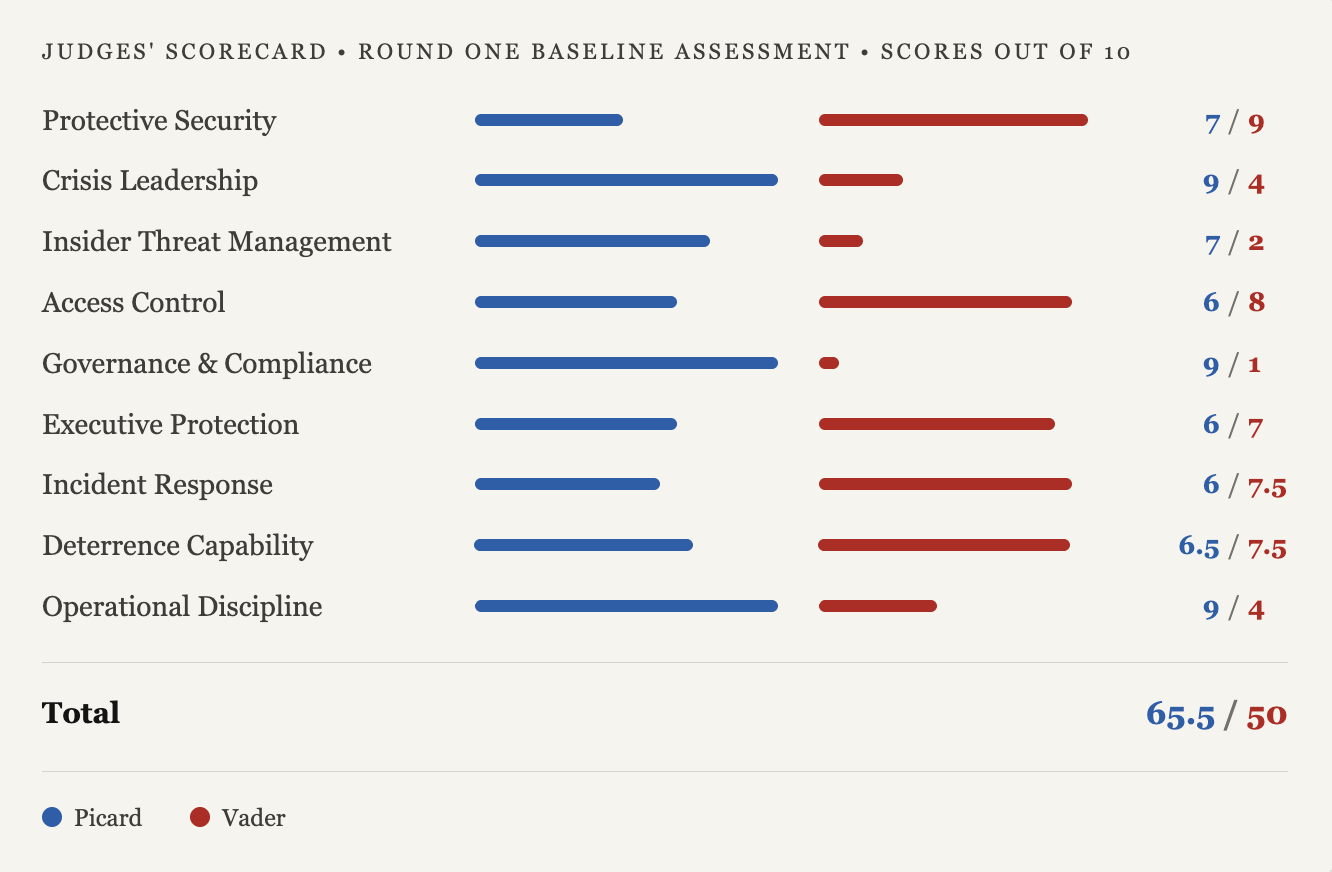
Vader's deterrence capability is extraordinary. His governance capability is non-existent. In security leadership, the combination does not average out. It detonates. The organisation that cannot speak honestly to its leader about what is going wrong is not a secure organisation. It is a disaster with a countdown.
The Broader Verdict
The case for Vader is real, if uncomfortable. In environments where immediate coercive capability is the primary security requirement, where threats are physical and adversaries are deterred by demonstrated willingness to use overwhelming force, Vader's operational model produces results. Security practitioners who have worked in genuinely hostile environments will recognise, however reluctantly, that projecting an unmistakable capacity for force is not a morally neutral activity but it is sometimes the correct one.
But the CSO role is not solely, or even primarily, about tactical dominance. It is about building and sustaining an organisational security posture over time, across a range of threats, with a workforce that is engaged, informed, and willing to surface problems before they become crises. Every category in which Vader loses reflects a failure mode that compounds over time: the officer corps that has learned to hide bad news, the security culture that confuses compliance with capability, the governance vacuum that produces decisions accountable to no one, and the insider threat environment that Vader did not merely fail to manage but personally exemplified at the most consequential moment of his career.
Picard advances not through violence, not through domination, and not through aggressive breathing, but through intellect, composure, principle, and the radical proposition that competent security leadership does not require murdering one's own staff. His record demonstrates that an organisation which trusts its leader, raises its problems, and maintains its discipline through genuine commitment rather than coerced compliance is a more durable and more effective security organisation than any amount of intimidation can produce.
The panel notes, in closing, that Vader's tactical categories are strong enough to make him genuinely dangerous in specific scenario contexts, particularly those involving immediate protective security requirements, access control under direct threat, or incident response situations requiring rapid decisive action. The competition's later rounds are designed, in part, to test precisely those conditions. Picard's principled framework will face pressures it has not yet encountered in this baseline assessment. Whether it holds is a question that remains, for now, open.
PANEL DECISION • ROUND ONE, MATCH TWO
Captain Picard advances
By 65.5 points to 50, on aggregate score across nine foundational disciplines. Picard's dominance in governance, crisis leadership, operational discipline, and insider threat management outweighed Vader's significant advantages in protective security, access control, and incident response. The panel observes that Vader's score of 50 is not negligible, and that specific operational scenarios in later rounds may favour his particular capabilities sharply. He does not advance. The threat he represents to those who do advance has been formally noted.
Next match in the World's Greatest CSO Competition: to be announced. The panel reminds all remaining contestants that Round One baseline assessments establish profiles, not destinies. The quarter-final scenarios will introduce operational conditions under which several current assumptions about the likely finalists may require significant revision. Lord Vader is asked to note that the panel's decision is final, and is asked further not to demonstrate his views on this point through any mechanism involving the Force. He exits the competition. Likely through a cloud of steam and ominous orchestral music.