

Match 1 - Captain George Mainwaring VS Lt. Frank Drebin
🏆 WORLD’S GREATEST CSO COMPETITION 🏆
ABOUT THE COMPETITION FORMAT
Before the tournament moves into complex operational scenarios, the opening round focuses on foundational leadership capability. Not who would necessarily prevail in every crisis, but which contestant demonstrates the stronger baseline characteristics expected of a modern Chief Security Officer: leadership philosophy, governance maturity, operational style, and organisational culture. Think of this as the fitness test before the field exercises begin. Later rounds will confront each remaining contestant with the same specific crisis scenario, where context will matter enormously and the rankings will shift in ways the opening round cannot predict.
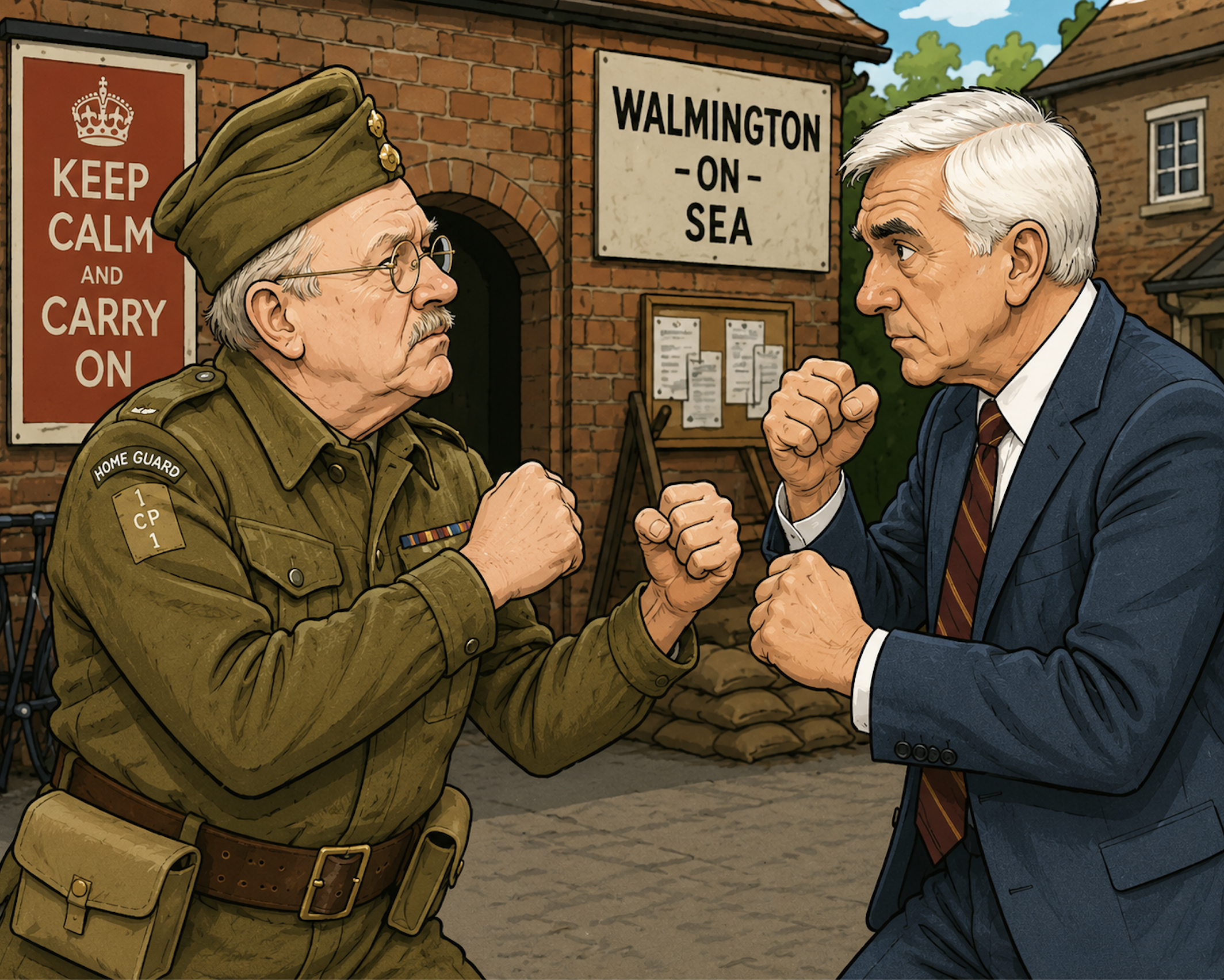
Two men. One role. Zero margin for further catastrophe.
In the opening match of our competition to crown the world's greatest Chief Security Officer, we pit a pompous bank manager turned Home Guard commander against a detective whose crime scenes typically end with more structural damage than they began with.
Both are, in their own way, legends. Only one can progress.
The Real Question This Matchup Poses
At first glance, this contest appears to be a straightforward collision between competence and incompetence. It is not. The deeper question is considerably more interesting, and considerably more relevant to anyone who has spent serious time in security leadership.
Every security organisation eventually encounters two dangerous archetypes. The first is the leader who possesses unwavering confidence in procedure, hierarchy, and authority, irrespective of whether any of those things are actually working. The second is the individual who generates continuous operational chaos yet somehow survives each disaster through a combination of luck, persistence, and institutional tolerance that defies both risk management and basic physics.
Captain George Mainwaring is the first archetype in its purest form. Lieutenant Frank Drebin is the second. The competition panel's task in this opening round is therefore not to determine which man would prevail across all possible security contexts. It is to ask which foundational profile better equips a leader for the CSO role before scenarios, pressure, and genuine operational complexity are introduced. The answer, it turns out, is not as clean as it first appears.
Setting the Scene
The Chief Security Officer role has never been more demanding. Organisations face a convergence of threats: opportunistic crime, geopolitical volatility, insider risk, reputational exposure, and the ever-present challenge of making governance feel relevant to those who fund it. The ideal CSO must be strategically sound, operationally credible, and capable of holding the confidence of a board that would genuinely prefer not to think about security at all.
Captain George Mainwaring of Walmington-on-Sea's Home Guard platoon and Lieutenant Frank Drebin of the Police Squad represent two philosophical poles. Mainwaring offers structure, authority, and a bone-deep conviction that if the paperwork is in order, the situation is in hand. Drebin offers something else entirely: a kind of kinetic, accidental competence that produces results through mechanisms that defy conventional risk frameworks and would certainly defy professional indemnity insurance.
Let us assess them fairly, discipline by discipline.
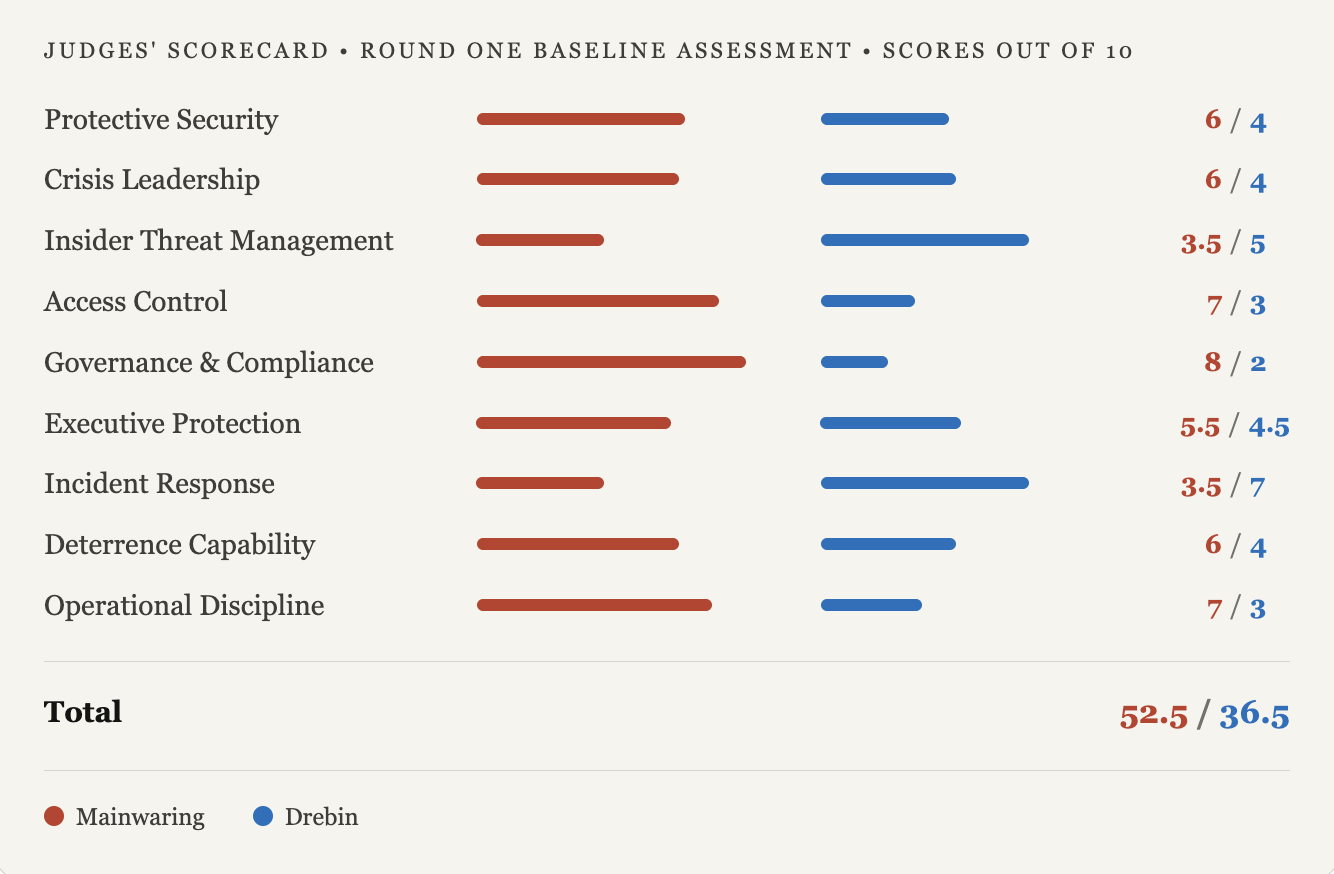
Protective Security
Mainwaring's approach to protective security is, in principle, admirable. He establishes a perimeter, assigns posts, conducts patrols, and insists on the correct use of challenge-and-response procedures. His worldview reflects a mid-twentieth century protective security mindset in which security is achieved through structure, vigilance, and the projection of confidence, and this model is not entirely without merit. In physical security environments, visible order often matters more than organisations care to admit. A competent security presence can deter opportunistic behaviour, reassure stakeholders, and reinforce behavioural expectations long before any technological control becomes relevant. Many experienced practitioners will quietly acknowledge that a well-positioned and disciplined guard, projecting calm authority, can prevent more incidents than expensive technology implemented poorly. Mainwaring instinctively understands this.
His problem is that he mistakes the appearance of order for actual capability. That his perimeter is guarded by men whose average age approaches seventy, whose rifles are frequently unloaded, and whose night vision is compromised by bifocals does not, in Mainwaring's view, constitute a vulnerability. The distinction between administrative confidence and operational resilience is one of the most persistent weaknesses in contemporary security governance, and Mainwaring embodies it with remarkable consistency.
Drebin's protective security record is, to put it diplomatically, complicated. He secures what he is asked to secure, but the collateral disruption to surrounding persons, property, and civic infrastructure tends to create secondary vulnerabilities that more than offset the original protection achieved. When Drebin guards a dignitary, the dignitary is typically safe. The buffet table, the bandstand, and the municipal fountain are not.
Advantage: Mainwaring, narrowly. His posture is coherent even when his resources are not.
Crisis Leadership
This is where the competition becomes genuinely interesting, and where the simplistic reading of this matchup breaks down entirely.
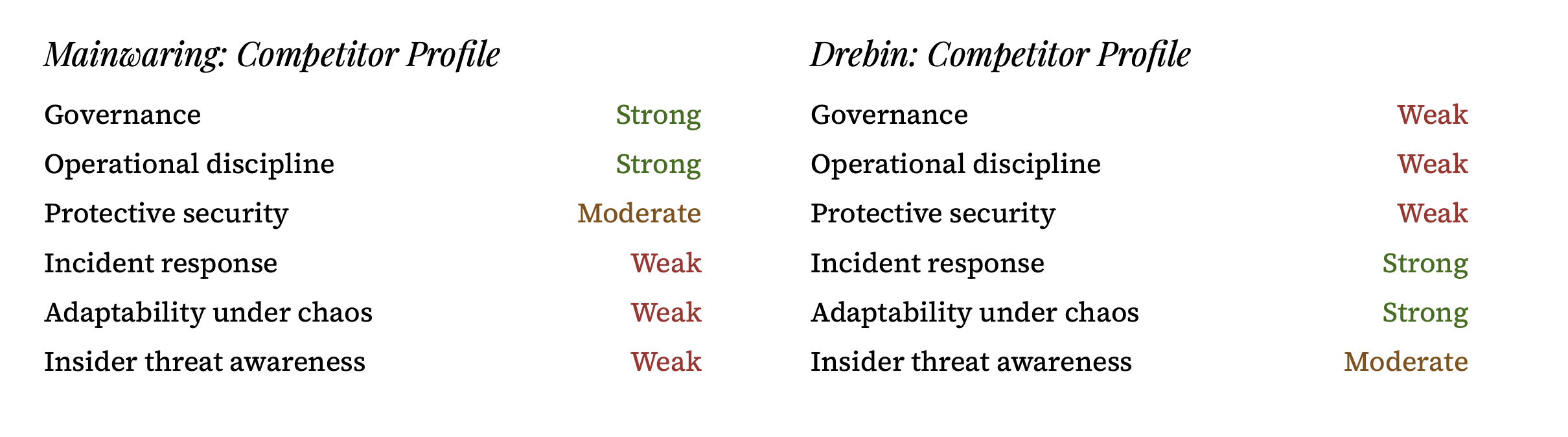
Mainwaring performs best when roles are clear, authority is recognised, procedures are stable, and events unfold predictably. Drebin, by some dark miracle, performs best when nothing makes sense, plans have collapsed, and everybody else is already panicking. Modern crisis leadership requires a balance of both traits. A capable CSO needs procedural discipline before an incident and adaptive judgement during it. Too much Mainwaring produces bureaucracy without agility. Too much Drebin produces chaos without accountability.
In a genuine crisis, Mainwaring exhibits the qualities that made British middle management simultaneously insufferable and indispensable for most of the twentieth century. He is decisive. He is calm, or at least performs calmness with sufficient conviction to steady those around him. His briefings, delivered with the authority of a man who has confused self-assurance with expertise, nonetheless produce a coherent response. Sergeant Wilson's weary counter-opinion is routinely dismissed, which is almost always a mistake, but the platoon acts.
Drebin, in a crisis, is the crisis. And yet there is an uncomfortable lesson buried inside the comedy. Many organisations struggle during real incidents not because they lack procedures, but because nobody is willing to make a decision once conditions stop matching the plan. Drebin has no such hesitation. He acts, frequently unwisely and frequently destructively, but decisively. His absurd effectiveness occasionally stems from a complete absence of institutional paralysis, and that is a quality no organisation should entirely dismiss. It is a quality that may matter considerably more in later rounds, when the panel introduces scenarios in which structured plans collapse rapidly and the ability to improvise under pressure becomes a decisive variable.
Advantage: Mainwaring, but less convincingly than the governance column alone would suggest.
Insider Threat Management
Here the analysis becomes unexpectedly symmetrical, and not in a flattering way for either candidate.
Mainwaring is almost entirely blind to insider threat, but for a specific and instructive reason: he trusts authority structures rather than individuals. He assumes that those operating within the system are fundamentally loyal if they respect process and hierarchy. This is a classic vulnerability. Many insider threat cases emerge precisely because organisations overestimate the protective value of procedural conformity. Private Walker's entrepreneurial side-interests alone would trigger a modern conflicts-of-interest register. Private Fraser's persistent catastrophism is either a psychological risk flag or a very effective morale suppressant, and Mainwaring never quite decides which. His failure to act on the obvious eccentricities, divided loyalties, and occasional insubordination of his own team represents a governance failure that has its real-world equivalent in every organisation that has ever been surprised by the colleague nobody wanted to name.
Drebin, by contrast, is too consumed by immediate chaos to maintain meaningful behavioural oversight. His suspicion is indiscriminate rather than calibrated, which is not the same thing as vigilance. He treats every bystander as a potential adversary, which is exhausting for everyone involved and produces a baseline alertness that lacks the analytical rigour to identify who actually warrants concern.
Both men would probably miss a genuine insider threat, but for entirely different reasons. Mainwaring because he trusts the system too completely. Drebin because he cannot see past the nearest exploding door. In a later scenario designed specifically to surface insider compromise, neither man looks especially comfortable.
Advantage: Drebin, marginally, and the panel notes this is largely a case of broken clocks.
Access Control
Mainwaring's challenge-and-response procedures are legendary, at least within Walmington-on-Sea. He devised them, he enforces them with theological rigour, and he becomes genuinely distressed when they are not observed. The fact that the responses are periodically forgotten by the very men he trained, or are overheard by passers-by and thus rendered ineffective, does not diminish his commitment to the principle. Access control, in Mainwaring's world, is a moral issue as much as a practical one.
It is worth noting, however, that excessively rigid access control cultures carry their own risks. Organisations operating under overly procedural security regimes can inadvertently discourage initiative and suppress escalation reporting. Personnel become more concerned with avoiding blame than identifying emerging risk. Mainwaring's style borders on this territory, though his personal commitment to accountability at least means the system is applied, if imperfectly.
Drebin's relationship with access control is best described as osmotic. He moves through controlled environments by projecting authority he has not been granted, presenting credentials of ambiguous authenticity, and occasionally walking through the wrong door entirely. This should result in ejection. It frequently results in him accessing areas of genuine operational sensitivity, which is either a damning indictment of the systems he encounters or evidence of a talent so idiosyncratic as to be useless as a teachable approach.
Advantage: Mainwaring, and it is not close. The principle of zero trust begins with actually having a system.
Governance and Compliance
Mainwaring was, before the war, a bank manager. This is not incidental. He brings to security governance the same instinct he brought to lending decisions: a love of documentation, a respect for hierarchy, and a mild contempt for those who cannot produce the relevant paperwork on demand.
Procedural theatre is a recurring failure mode in security governance: impressive policies, exhaustive compliance frameworks, elaborate escalation pathways, and highly visible governance structures, combined with very limited practical resilience. The result is an organisation that appears secure during audits yet performs poorly during genuine disruption. Mainwaring would almost certainly excel at producing documentation, conducting briefings, and ensuring attendance sheets are signed. Whether those controls would function during a rapidly evolving incident is another matter, and one which future rounds may test directly.
That caveat noted, the ability to project governance confidence to a board is not a trivial skill. Security leaders frequently operate as translators between operational reality and executive expectation, and a CSO who cannot communicate structure and assurance will struggle to maintain organisational trust regardless of their operational capability. Mainwaring's security programme would generate excellent records, detailed standing orders, and thorough after-action reports. Whether the reports would accurately capture what actually happened is a separate question, but they would exist, correctly filed and properly indexed.
Drebin does not do governance. He is aware that governance exists in the way that one is aware of dental appointments: abstractly, and with a preference not to engage. His reports, when submitted, are works of accidental surrealism that satisfy neither the letter nor the spirit of regulatory requirements. No insurer in the world would willingly underwrite his operating model. No board would sleep soundly knowing he was running the programme.
Advantage: Mainwaring, comprehensively.
Executive Protection
Mainwaring would likely overcomplicate executive movement with excessive formality and unnecessary ceremony. Drebin would accidentally shoot the principal's driver while attempting to neutralise a pigeon. Neither outcome inspires confidence.
Mainwaring's approach is at least process-driven: routes are planned, signals are agreed, and the principal is moved according to a scheme that, while never quite sufficient for the actual threat environment, at least demonstrates intent and offers some basis for post-incident review. In executive protection, consistency often matters more than flair. His protectees are occasionally bewildered by the solemnity of the arrangements, but they arrive where they are supposed to be.
Drebin's close protection record ensures the principal's survival at the cost of nearly everything else in the immediate vicinity. A night at the opera with Drebin as protector ends with the principal unharmed, the orchestra traumatised, and the chandelier on the floor. This is, in the narrowest sense, a success, but no security programme can absorb that rate of collateral consequence indefinitely.
Advantage: Mainwaring. The panel suggests neither candidate should be permitted near heads of state unsupervised.
Incident Response
Drebin's only genuine area of clear superiority, and it is substantial. When an incident occurs, Drebin responds. Not elegantly, not proportionally, and rarely in a manner that could be mapped onto any recognised response framework. But he responds with complete commitment and, crucially, he typically achieves the objective. The perpetrator is apprehended, the bomb is defused, the conspiracy is unravelled. That three lamp-posts and a florist's shop have been sacrificed in the process is, from a pure incident resolution standpoint, beside the point.
Mainwaring's incident response is hamstrung by a combination of inter-agency friction, resource limitations, and a tendency to convene a committee at moments that call for immediate action. He resolves incidents, but the timeline is longer than it needs to be and the path is strewn with procedural detours. The real-world implication is familiar: organisations that have invested heavily in process and insufficiently in empowering people to deviate from it when conditions demand will always be slower than the threat.
Advantage: Drebin. When seconds matter, process can wait. This finding should concern anyone who assumes Mainwaring's procedural confidence will hold under genuine operational pressure in later rounds.
Deterrence Capability
Deterrence is perhaps the most psychologically complex element of the security discipline, and it is here that Mainwaring makes his strongest case. He genuinely believes in his own deterrent effect, and that belief, communicated consistently and with considerable force of personality, does produce a degree of deterrence. Adversaries encountering Mainwaring are confronted with a man who will absolutely not be intimidated, who will cite chapter and verse of the relevant regulations, and who will, if necessary, stand in the road and refuse to move. Competence is not entirely required. Conviction, projected consistently, is itself a control.
Drebin deters through unpredictability, which is a legitimate deterrence strategy but one that sits uneasily in a structured security programme. Rational adversaries avoid Drebin not because they fear his capabilities but because they fear the consequences of being anywhere near him when something goes wrong. This is deterrence by reputation for chaos, and while it works, it is neither scalable nor insurable.
Advantage: Mainwaring. Deterrence with dignity beats deterrence through notoriety.
Operational Discipline
This is the decisive category in a baseline assessment, and it is decisive for reasons that go beyond the obvious.
Security leaders do not merely respond to incidents. They shape organisational behaviour long before incidents occur. The strongest security cultures are characterised by calm professionalism, clarity of authority, procedural consistency, measured escalation, and psychological stability. These qualities are cultivated over time through the example set by whoever sits at the top of the function. Mainwaring, despite all his flaws, contributes to those outcomes. He creates disciplined environments. Personnel know what is expected of them. The standard is clear, if not always met.
Drebin survives within collapsing environments. He does not build them, and he certainly does not sustain them. His operational discipline is an oxymoron: he proceeds on instinct, improvises constantly, and treats established procedure as a loose suggestion. His outcomes are not the product of disciplined process but of a peculiar genius that cannot be replicated, trained, or institutionalised. No security organisation can be built on Drebin's methods, because his methods are, technically speaking, not methods at all. They are personality. Whether that personality becomes an asset in genuinely chaotic scenario conditions is a question the competition's later rounds are designed to answer.
Advantage: Mainwaring. Discipline requires structure, and structure requires someone who believes in it enough to enforce it even when it is inconvenient.
Mainwaring governs like a man who has read the manual, memorised the manual, and fully intends to be buried with the manual. Drebin governs like a man who has never heard of the manual but will somehow rescue the manual from a burning building while setting the building on fire.
The Broader Verdict
In the real world, security programmes fail in two distinct ways. They fail because no one in charge cares sufficiently about process, consistency, or accountability. And they fail because the organisation becomes so enamoured of its own procedures that it loses the capacity to act when acting is what the moment demands. Mainwaring embodies the first failure mode's antidote and the second failure mode's natural habitat. Drebin embodies the first failure mode in its purest form, redeemed only by outcomes that cannot be explained within any conventional framework.
In the context of this opening round, which asks only who brings the stronger foundational profile to the CSO role, Mainwaring is the clearer answer. He builds a security programme that functions: badly, with the wrong resources, and in spite of itself, but it functions. Drebin's programme does not function. It occasionally and spectacularly succeeds, which is a different thing entirely.
Security competence is not merely technical. It is behavioural and cultural. The ability to project calm authority during uncertainty is itself a protective control, and it is one that can be taught, scaled, and sustained. Mainwaring may never successfully defend Walmington-on-Sea from invasion, but he would conduct the briefing, secure the perimeter, document the incident, and ensure everybody signed the attendance sheet.
And yet the panel is not entirely comfortable closing the door on Frank Drebin. Beneath the comedy lies an uncomfortable truth: in fast-moving crises where structured plans collapse and conventional thinking fails, imperfect action can outperform paralysed process. Mainwaring advances on governance, discipline, and structural coherence. But whether his procedural confidence can survive genuinely complex operational pressure, the kind the competition's later rounds are designed to introduce, remains an open and entirely legitimate question. Future scenarios will test that proposition directly. Not every round will reward the man with the most complete filing system.
PANEL DECISION • ROUND ONE, MATCH ONE
Captain Mainwaring advances
By 52.5 points to 36.5, on aggregate score across nine foundational disciplines. Mainwaring advances not because he is flawless, but because organisations generally survive procedural rigidity more readily than operational anarchy. Drebin's adaptability in chaotic environments and his instinct for decisive action may, however, have been undervalued by a format that rewards structure. The panel notes this. Future rounds will not be so forgiving of either man's weaknesses.
Next match in the World's Greatest CSO Competition: to be announced. The panel is reviewing the remaining nineteen entrants and will confirm the next pairing shortly. All contestants are reminded that Round One baseline assessments do not determine final rankings. Scenario-based operational evaluations begin in the quarter-finals. The competition remains, at this stage, genuinely open.